
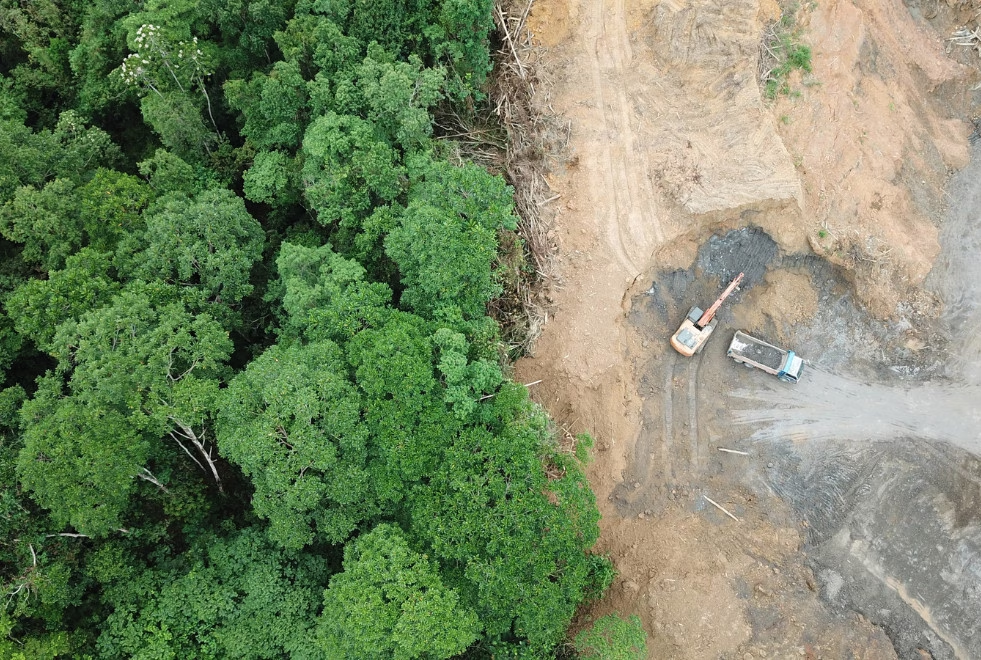
Sumatra’s forests, once the primary guardians of the island’s ecological balance, now bear deep scars. Recent environmental disasters across three provinces serve as a stark reminder that ecological damage is not merely an abstract term, but a harrowing reality for the communities left to deal with the aftermath.
The long-term accumulation of extractive activities—ranging from industrial forestry and palm oil plantations to mining—has led to a significant decline in the environmental carrying capacity of Aceh, North Sumatra, and West Sumatra. While the government has taken the step of revoking the business permits of 28 companies held responsible for this degradation, the Indonesian Forum for Environment (WALHI) argues that permit revocation alone does not address the root of the crisis.
WALHI contends that decades of ecological damage cannot be healed simply by halting corporate operations on paper. Environmental recovery demands more fundamental and sustainable actions. In their view, the revocation of permits must be seen as a starting point for restoration, not an end goal. These measures only gain true meaning if followed by comprehensive ecological rehabilitation and the restoration of the rights of affected communities.
The Toll of Cumulative Ecological Damage
Environmental advocates view Sumatra’s current ecological crisis as the result of a long history of extractive practices that have consistently ignored the limits of nature. Large-scale forestry, industrial plantations, and mining have fundamentally altered forest landscapes and watersheds, stripping ecosystems of their natural ability to absorb water and mitigate disasters. This systemic damage is directly linked to the increasing frequency and severity of floods and landslides across the region.
Boy Jerry Even Sembiring, the National Executive Director of WALHI, emphasized that the state’s responsibility must go beyond administrative sanctions. He warned that the government must ensure former concession areas are not simply transferred to other entities—whether state-owned enterprises (BUMN) or private firms—without a clear and transparent restoration plan.
“The state must guarantee that the revocation of business permits in Aceh, North Sumatra, and West Sumatra is not a backdoor for reallocating those areas to other companies. Furthermore, the state must ensure that the companies whose permits were revoked are held legally and financially accountable for restoring the land they damaged,” Sembiring stated.
Persistent Environmental Conflicts and the Demand for Justice
A prominent case highlighted by WALHI is the permit revocation of PT Toba Pulp Lestari (TPL) in North Sumatra. This concession has been a source of prolonged conflict with local indigenous communities since the 1980s, dating back to when the company operated as PT Indo Rayon. In 1988, a landmark lawsuit against PT Indo Rayon became a historic milestone in Indonesian law, as the courts first recognized the legal standing of environmental organizations to sue corporations.
Rianda Purba, Executive Director of WALHI North Sumatra, stressed that the revocation of TPL’s permit must be accompanied by two non-negotiable steps: the return of concession lands to indigenous peoples and a mandatory, full-scale environmental restoration by the company. He warned against repeating history—referring to when PT Indo Rayon’s permits were previously revoked, only for the company to resume operations under the new name, TPL.
“Without these two actions, the revocation is merely a symbolic gesture that fails to solve the underlying issues,” Purba asserted.
The Shadow of Illegal Mining
In West Sumatra, the government has revoked the permits of three companies operating in the Mentawai Islands: PT Minas Pagai Lumber, PT Biomassa Andalan Energi, and PT Salaki Suma Sejahtera.
However, WALHI West Sumatra points out that these actions have yet to address the widespread Illegal Gold Mining (PETI) activities that contribute significantly to regional flooding. Wengky Purwanto, the regional director, criticized the lack of decisive action from law enforcement against illegal operators.
“If this continues, these disasters will keep recurring, and the perpetrators will continue to mine without fear of legal consequences,” Puranto warned.
Transparency in Government Evaluation
Questions have also surfaced regarding the transparency and accuracy of the government’s evaluation process. Ahmad Solihin, Executive Director of WALHI Aceh, identified several irregularities in the revocation lists. For example, companies such as PT Rimba Timur Sentosa and PT Rimba Wawasan Permai, which were reportedly revoked in 2022, reappeared on the latest 2026 list.
“Evaluations must lead to concrete action against companies that have a clear track record of contributing to environmental damage and disasters, such as PT Tualang Raya, PT Wajar Korpora, and PT Tusam Hutani Lestari,” Solihin noted.
WALHI concludes that permit revocations must trigger a broader, participatory review of all active permits across Sumatra. This should include a total revision of spatial planning policies based on ecological carrying capacity. Without public participation and a foundation of ecological science, these policy shifts risk being merely symbolic while the wounds of Sumatra’s forests remain unhealed.
- An Urgent Plea for International Aid from the Heart of Indonesia’s Toxic Haze Crisis
- How the Savannas of Nusa Tenggara Became Indonesia’s New Epicenter for Land Fires
- Why World Mangrove Day Requires Action, Not Just Rhetoric?
- Fair Finance Asia Promotes Collaboration on Energy Transition
- The Smoke Crisis and Methane Time Bomb at Jatiwaringin Landfill
- One Year Since the Maba Sangaji Forest Tragedy


