
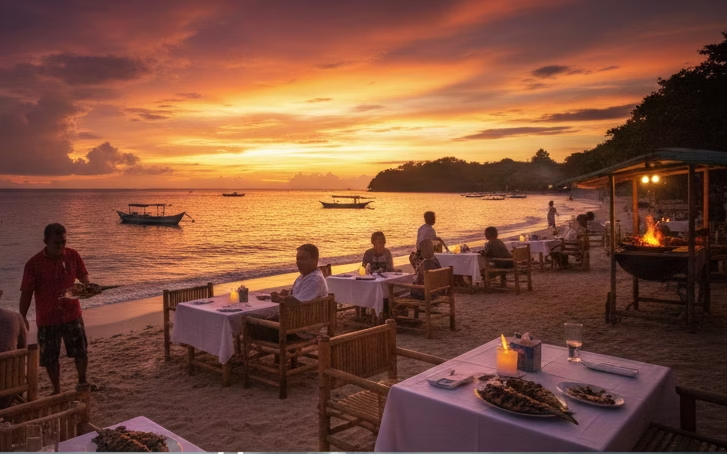
The sun dips below the horizon in Labuan Bajo, painting the sky in bruises of purple and gold. On the shore, the air is thick with the mouth-watering scent of charcoal-grilled snapper and lime-drenched calamari. Tourists from across the globe sit at candlelit tables, waiting for the “catch of the day.”
But behind the smoke of the grill and the clinking of Bintang bottles, a quiet crisis is brewing. In Eastern Indonesia, the journey from the sea to the table is no longer a straight line—it’s a zig-zag through storms that weren’t supposed to be there.
The Vanishing Rhythm
For Om Elias, a fisherman in East Nusa Tenggara (NTT) who has read the stars and the currents for forty years, the ocean used to be a clock. You knew when the Musim Barat (West Monsoon) would howl, and you knew when the seas would be glass.
“The ocean has lost its pulse,” Om Elias says, adjusting a nylon net that has seen better days. “Before, we followed the moon. Now, the wind changes its mind three times a day. We head out under a clear sky, and two hours later, we are fighting waves that want to swallow the boat.”
This isn’t just a story about bad weather; it’s about climate change reshaping the geography of hunger. As the Indonesian throughflow—the massive current that moves water between the Pacific and Indian Oceans—warms up, fish populations are moving to deeper, cooler waters. For local fishermen with small wooden perahus, those depths are out of reach.
The Culinary Tourism Gamble
Eastern Indonesia—from the Komodo dragon’s lair to the spice-scented air of the Banda Islands—has branded itself as a seafood paradise. Culinary tourism is the lifeblood of the region. Travelers don’t just come for the views; they come for the authenticity of a fish caught that morning.
However, the “Sea to Table” promise is becoming increasingly difficult to keep:
- Supply Volatility: When unpredictable storms keep fleets grounded for weeks, restaurants must fly in frozen seafood from Bali or Surabaya. The “local” snapper on your plate might have more air miles than you do.
- The Price of Scarcity: As local catches dwindle, prices skyrocket. A plate of grilled prawns that was once affordable for a local family is now a luxury reserved for high-end resorts.
- The Loss of Variety: Species like the Napoleon Wrasse and certain groupers are becoming rare sights, replaced by smaller, less commercially viable fish.
Warming Waters, Bleaching Dreams
The heart of the problem lies beneath the surface. Eastern Indonesia sits at the center of the Coral Triangle. As sea temperatures rise, coral bleaching turns vibrant underwater cities into white skeletons. When the reefs die, the “nursery” for the seafood we love disappears.
For the culinary traveler, this means a change in the menu. For the fisherman in NTT, it means a change in destiny. Many are forced to abandon their nets to become boat drivers for tourists or seaweed farmers—occupations that are also at the mercy of the warming sun.
“We are the guardians of the sea, but how do you guard something that is changing its soul?” — Local fisherman, Alor Archipelago.
Finding a New Current
Despite the grey clouds, there is a glimmer of resilience. In parts of Eastern Indonesia, communities are turning to Sasi—an ancient customary law that forbids fishing in certain areas during specific times to allow stocks to recover.
Restaurants in Labuan Bajo are also beginning to educate tourists, moving away from “glamour species” like Bluefin Tuna toward more sustainable, locally abundant options like mackerel or farm-raised barramundi.
The future of Eastern Indonesia’s table depends on this delicate balance: acknowledging that the ocean is no longer an infinite pantry, but a fragile ecosystem that requires us to change our appetites.
The next time you sit by the beach in NTT, enjoying a plate of grilled fish, take a moment to look past the plate. The flavor of the sea is still there, but it’s seasoned now with a pinch of uncertainty. The journey from sea to table is getting harder, and it’s a journey we all need to help protect.