
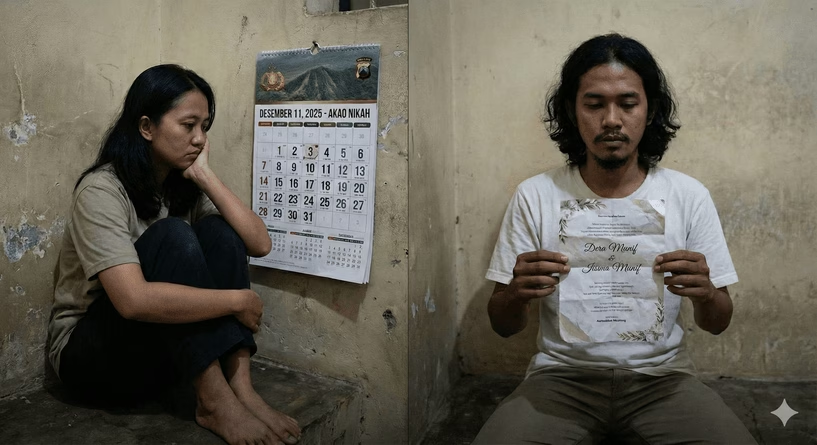
December 11, 2025, was supposed to be the happiest day of Adetya “Dera” Pramandira and Fathul Munif’s lives. The wedding invitations had been sent, and preparations for their ceremony in Madiun were complete. But instead of standing side-by-side at the altar, the couple—both prominent environmental activists in Central Java—found themselves separated by the cold walls of prison cells. Dera is currently detained at the Central Java Regional Police headquarters, while Munif sits in a cell at the Semarang Metropolitan Police station.
Their love story, which blossomed amidst the dust and heat of advocacy work—defending the rights of villagers in Wadas and supporting farmers in Jepara and Kendal against environmental exploitation—is now facing its toughest trial. It is not a test of family approval, but a sudden legal entalgle that shackled them just two weeks before they were due to say “I do.”
A celebration turned nightmare
The arrest of Dera (26) and Munif (28) on Thursday, November 27, 2025, sent shockwaves through Indonesia’s civil society. Both were named suspects for alleged violations of the Electronic Information and Transactions (ITE) Law and “incitement,” linked to social media posts regarding the “Emergency Warning” (Peringatan Darurat) demonstrations that swept the country in August 2025.
Legal experts and fellow activists have flagged serious procedural irregularities in their detention. The couple was immediately arrested and detained without ever receiving a prior summons for questioning as witnesses—a standard procedure in Indonesian law.
“They were designated as suspects on November 14, arrested on November 27, yet they were never even informed of their suspect status,” revealed Mahfud MD, a member of the National Police Reform Acceleration Team (Tim Percepatan Reformasi Polri), in a statement on Thursday, December 4, 2025.
This case is increasingly seen not as routine law enforcement, but as a stark warning of how the judicial system can be weaponized to silence critical voices—a phenomenon globally known as SLAPP (Strategic Lawsuit Against Public Participation).
High-Level intervention
The outcry over Munif and Dera’s detention has reached the highest levels of national oversight. The Police Reform Acceleration Team, a body tasked with cleaning up the police institution, has publicly urged National Police Chief General Listyo Sigit Prabowo to release the two activists.
Mahfud MD emphasized that environmental defenders possess a specific legal immunity guaranteed by Indonesian law. “We expect these environmental activists to be released immediately because they are explicitly protected by the law,” he asserted.
Echoing this sentiment, Jimly Asshiddiqie, Chairman of the Police Reform Team, reminded law enforcement of the state’s obligation on Friday, December 5, 2025. “Anyone fighting for the right to a good and healthy environment cannot be criminally prosecuted or sued civilly. That is the letter of the law. We hope they are released immediately,” Jimly stated.
Understanding the “Ghost” of SLAPP
The plight of Munif and Dera serves as a textbook example of why understanding SLAPP is critical for Indonesian democracy. According to documents from the Indonesian Center for Environmental Law (ICEL), SLAPP is a strategy designed not necessarily to win a court case, but to stop citizens from exercising their political rights.
The primary goal of a SLAPP action is intimidation. By transforming a public issue—such as environmental destruction or democratic backsliding—into a private legal battle (criminal or civil), perpetrators aim to drain the activists’ resources, inflict psychological trauma, and ultimately silence opposition.
In this case, the pattern is clear: public attention, which should be focused on the democratic aspirations and environmental concerns raised by Munif and Dera, has been diverted into a narrative of individual criminality.
Anti-SLAPP: a shield for defenders
Indonesia legally possesses a “cure” for the poison of SLAPP. This protection is enshrined in Article 66 of Law No. 32 of 2009 on Environmental Protection and Management.
The article unequivocally states:
“Every person fighting for the right to a good and healthy environment cannot be criminally prosecuted or sued civilly.”
This “Anti-SLAPP” provision is designed to provide two critical protections:
- Activists should not fear imprisonment for speaking the truth or criticizing policies that harm the environment.
- Reinforced by a Supreme Court Decree (SK KMA No. 36 of 2013), the Anti-SLAPP defense can be raised early in legal proceedings. If proven, the case should be dismissed immediately, sparing activists from long, exhausting trials.
Today, the fate of Munif and Dera—and the broader future of civil liberties in Indonesia—hangs on whether law enforcement will honor this “sacred” article. If the police reform agenda is to be taken seriously, releasing Munif and Dera is not just about allowing a wedding to proceed; it is about restoring the law to its true function: a shield for the people, not a weapon against them.
- Traditional Dish Adds To Threats Facing Indonesia’s Carnivorous Plants
- The Blue Carbon Paradox: Indonesia’s Ecological Gamble on World Seagrass Day 2026
- West Java Besieged by Indonesia’s Deadliest Coal Power Plants
- Green Illusions: The Failing Promise of Indonesia’s Biomass Energy Plantations
- The Dark Shadow Behind the Copper Glint: Locking Papua’s Fate into Ecological Disaster
- Criminalized for Their Land: The Struggle of Sagea Residents Against Nickel Mining in North Maluku