In the heavy, humid air of a December afternoon, Tarsisius Fendy Sesupi sat in the Link-AR Borneo office, reflecting on a stack of documents that cataloged a tragedy. As a traditional leader of the Dayak Kualan and the head of Lelayang Village, Fendy’s life has become a record of lost forests and shrinking ancestral spaces under the shadow of PT Mayawana Persada.
But the quiet of his reflection was shattered on December 9, 2025, just one day before International Human Rights Day. White vehicles pulled up to the office, and police officers arrived to take Fendy into custody. For the Indigenous networks in the region, the message was chillingly clear: within the Mayawana concession, speaking the truth carries a heavy price of fear.
Strangers on Their Own Land
Hours before the police arrived, Fendy had stood before reporters and members of the regional parliament, laying bare the grim reality facing communities in Ketapang and Kayong Utara.
“We are like strangers on our own land,” one resident accompanying Fendy told the press. “When we try to protect the little forest we have left, we are met with weapons and accusations of breaking the law.”
For the Dayak Krio, Dayak Simpang, and Dayak Jalai peoples, the 136,710-hectare concession isn’t just a coordinate on a Ministry of Forestry map. It is home to 38,500 people. It holds the rubber plantations that feed families, the rice paddies that sustain them, and the sacred burial grounds of their ancestors. “The forest is our breath,” another resident said. “If it disappears, our identity as Dayak people disappears with it.”
The Scars of Deforestation
The conflict is fueled by a staggering rate of environmental destruction. Data from Link-AR Borneo and Satya Bumi reveals that between 2016 and 2024, approximately 42,500 hectares of forest cover—an area equivalent to thousands of football fields—have been cleared.
The pace of destruction accelerated dramatically in 2023, with 17,839 hectares of natural forest razed, followed by another 4,633 hectares in 2024. Most of this clearing has occurred in carbon-rich peatlands, which serve as a critical global defense against climate change.
For the villagers, these statistics translate to the loss of traditional medicines, wild honey, and ritual sites. The concession lines have physically severed ancestral lands, blurring village borders and forcing communities to retreat from their own living spaces.
The Illusion of Consent
While the corporation claims to follow protocols for Free, Prior and Informed Consent (FPIC), testimonies from the ground suggest a different reality—one of pressure rather than partnership.
“They come with papers we don’t fully understand,” said a mother from the Dayak Jalai community. “They promise prosperity, but all we see is the forest vanishing and the rivers turning murky. We don’t need money that is gone in a day. We need the forest that can sustain our grandchildren forever.”
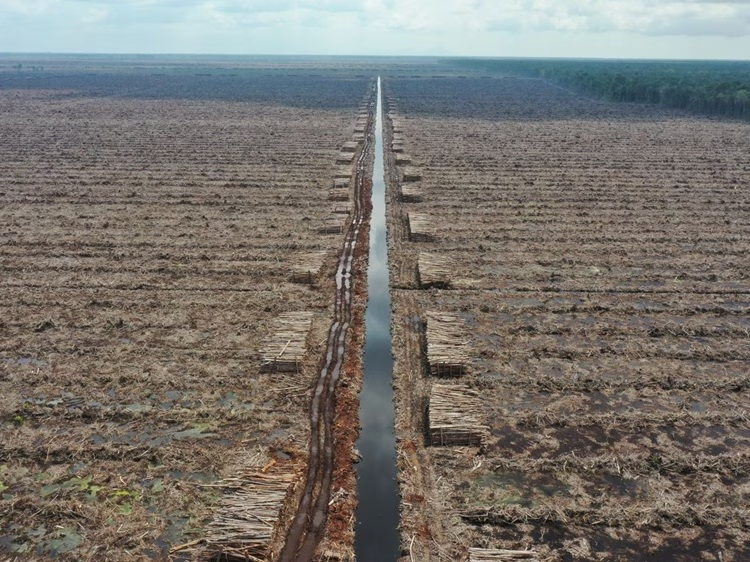
Today, massive canals cut through the peatlands, draining the life out of what remains of the natural forest. The conflict has evolved from a land dispute into a systemic threat to civil liberties. The attempt to forcibly detain Fendy is seen as a tactic to suppress dissent.
As heavy machinery continues its work, the struggle of West Kalimantan’s Indigenous people continues under the constant threat of criminalization. This massive deforestation is not just about falling trees; it is about the uprooting of cultural roots and a history that has inhabited this land for centuries.
“Don’t wait until the last tree falls to realize that you cannot eat money,” an elder warned—a stark reminder echoing through a forest that no longer carries the scent of the wild.
- Traditional Dish Adds To Threats Facing Indonesia’s Carnivorous Plants

- The Blue Carbon Paradox: Indonesia’s Ecological Gamble on World Seagrass Day 2026

- West Java Besieged by Indonesia’s Deadliest Coal Power Plants

- Green Illusions: The Failing Promise of Indonesia’s Biomass Energy Plantations
- The Dark Shadow Behind the Copper Glint: Locking Papua’s Fate into Ecological Disaster
- Criminalized for Their Land: The Struggle of Sagea Residents Against Nickel Mining in North Maluku