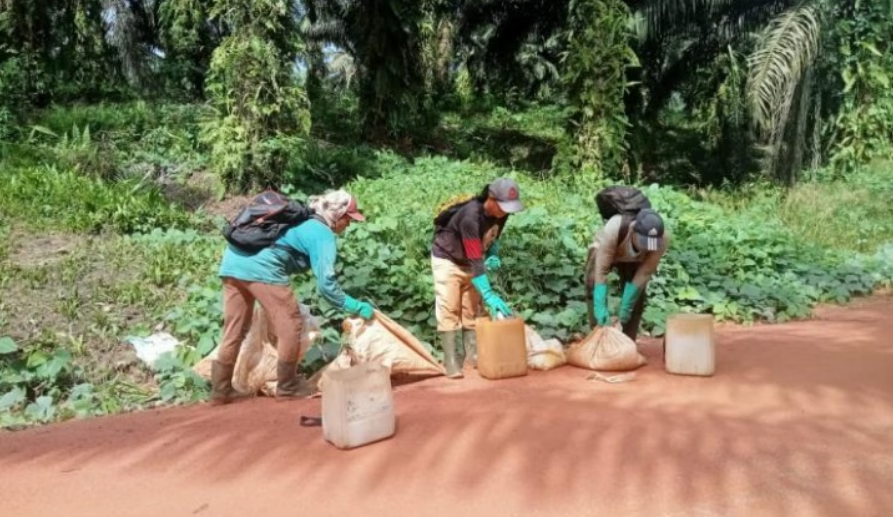
Before the dawn even has a chance to fully break over the Sanggau Regency of West Kalimantan, 41-year-old Patmawati is already engaged in a quiet, desperate struggle for breath. She isn’t afraid of the predators once found in the ancient Borneo jungles; she is afraid of her own lungs. Now a laborer for PT Sinar Inutwa Alami (SIA)—a subsidiary of the Lyman Group—she spends her days in a landscape of endless oil palms that have long since replaced the wild forest.
On this particular morning, a severe asthma attack left her trembling and gasping. When she begged for a moment of rest, she was met with the cold logic of the extractive industry: a laborer is merely a gear in a machine that cannot stop. The company told her that if she didn’t show up, her wages would be slashed and her employment status downgraded. Her story is not an isolated grievance; it is a vivid portrait of how the “extractive octopus” of the palm oil industry in West Kalimantan squeezes human dignity until there is nothing left.
For over a decade, West Kalimantan has been transformed into a playground for these industrial giants. Tropical forests, often called the lungs of the planet, are being methodically cleared to make way for monoculture plantations and massive mining pits. While the promise of local prosperity is often used to justify this destruction, the reality for those on the ground is far bleaker. The Teraju Indonesia Foundation describes a “bittersweet promise” within the system of plasma smallholders. Communities that once held sovereignty over their ancestral lands now find themselves trapped in systemic poverty.
According to Agus Sutomo, Executive Director of the Teraju Indonesia Foundation, farmers frequently hand over their land with the hope of becoming partners, only to be saddled with opaque development debts. Instead of being stakeholders, they become laborers on their own soil, crushed by unfair profit-sharing schemes while global buyers enjoy a steady stream of palm oil, often oblivious to the labor violations baked into the product.
The damage doesn’t stop at the plantation fence. This extractive greed has torn through the ecological balance of the region. The deforestation of the headwaters to facilitate expansion has created a hydrological crisis that is now closing in on the provincial capital, Pontianak. The destruction of these natural water absorption zones for the sake of capital accumulation has sent a wave of disasters downstream, with routine flooding and a decline in water quality becoming the new normal for coastal residents.
The exploitation Patmawati endured is just the visible peak of a much larger mountain of human rights violations. The West Kalimantan Palm Oil Workers Union Federation (FSBKS) reports that the disregard for basic rights is a daily occurrence. Workers face indefinite precarious employment, low wages that barely cover basic needs, and a total lack of health insurance. In one tragic instance, the absence of insurance led to the death of a worker’s child, as the family simply could not afford medical care. Beyond health, the lack of sanitation, broken infrastructure, and the absence of childcare facilities paint a grim picture of life behind the corporate curtain.
Breaking the tentacles of this octopus requires more than just words; it requires a dismantling of corporate impunity. Experts like Sutomo argue that the government must conduct rigorous audits of all mining and palm oil concessions in the province. There is a pressing need for transparency regarding the debts of plasma farmers and an absolute requirement that all workers—including daily casual laborers—be enrolled in national health and social security programs.
Furthermore, a total moratorium on new permits in the remaining forests of Kalimantan is essential to stop the ecological bleeding. But the pressure must also be global. International buyers must be held accountable for their supply chains, ensuring that the oil they purchase is not “stained with the blood and tears” of the people of Borneo.
As her shift ends, Patmawati looks out over the rigid, unnatural rows of palm trees. She is a witness to a stolen justice, standing on land that no longer feels like home. “We are not machines,” she says through the weight of her exhaustion. “We are humans who feel pain and have families. How long must we be forced to fight illness for wealth we will never see?” Her cry is the cry of West Kalimantan—a warning that if this extraction continues unchecked, all that will remain is a poisoned landscape and a people dying in the shadow of industrial grandeur.
This report was produced in collaboration between Ekuatorial and Kolase.ID.
- Traditional Dish Adds To Threats Facing Indonesia’s Carnivorous Plants

- The Blue Carbon Paradox: Indonesia’s Ecological Gamble on World Seagrass Day 2026
- West Java Besieged by Indonesia’s Deadliest Coal Power Plants
- Green Illusions: The Failing Promise of Indonesia’s Biomass Energy Plantations
- The Dark Shadow Behind the Copper Glint: Locking Papua’s Fate into Ecological Disaster
- Criminalized for Their Land: The Struggle of Sagea Residents Against Nickel Mining in North Maluku