
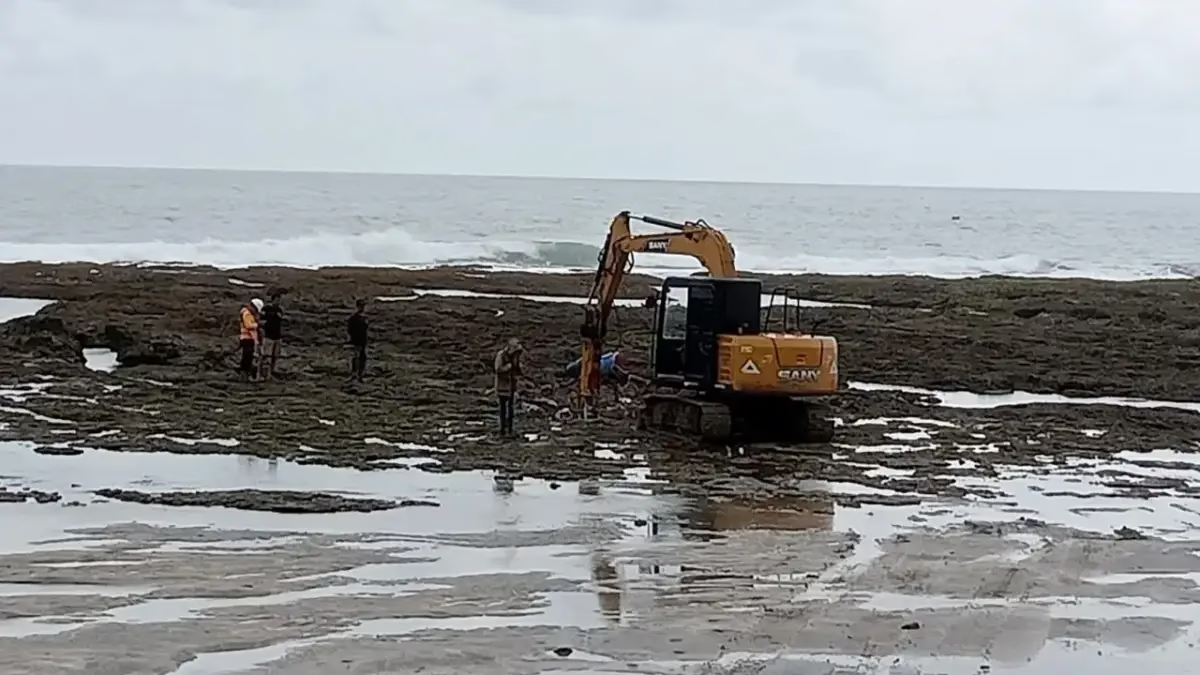
For Duden Suherlan, the waters off Minajaya Beach in West Java are far more than just a stretch of saltwater. It is here, among the sturdy crevices of the coral reefs, that the 56-year-old makes his living. Every day, he wades along the coast of Buniwangi Village, hunting for small fish and foraging seaweed to keep his family afloat.
But the morning calm of Monday, October 20, 2025, was violently disrupted. The interruption didn’t come from the notoriously fierce waves of the southern ocean, but from an unfamiliar, mechanical roar.
At the water’s edge, a heavy hydraulic breaker tore into the pristine coral clusters, dismantling the natural barrier piece by piece. Duden could only watch from a distance, too intimidated to approach the massive machinery.
“When the heavy equipment was there, I didn’t dare go near it. I just focused on looking for seaweed nearby,” Duden recounted softly. It wasn’t until the next day that he learned the activity had been halted. But by then, the anxiety had already taken root.
“If they need to lay down pipes, it shouldn’t be right here in the open sea,” he lamented. “There are reefs here that must be protected; they are breeding grounds for small fish.” For artisanal fishermen like Duden, destroying the coral means destroying the “home” of the fish, which ultimately means an empty dinner plate for his family.
The heavy machinery Duden witnessed was part of a massive pipe-laying project owned by PT Berkah Semesta Maritim (BSM). The company operates an industrial shrimp farm situated roughly 105 hectares wide, just a stone’s throw from the shoreline.
Their ambition is clear: to install gigantic pipes designed to suck up massive volumes of seawater to supply their shrimp ponds. But this ambition has triggered alarm bells throughout the local fishing community.
Agus Iskandar, Chairman of the Minajaya Beach Fishermen’s Association, cannot hide his deep concern. The farm’s proximity—a mere 200 meters from the beach—poses a direct, existential threat to their traditional fishing grounds.
“It will automatically disrupt the ecosystem. That is the exact spot where we moor our boats, set our nets, and dive for lobster,” Agus explained. He envisions the giant pipe acting like a colossal vacuum cleaner on the ocean floor. “It won’t just suck up water; the flora and tiny fish will be dragged away with it.”
Agus’s fears are grounded in recent history. The Minajaya Beach area is already home to three large shrimp farms—two have been operating for five years, while another is under construction. The environmental scars are already visible. Pointing to the Cimanala Shrimp Farm as an example, Agus noted that the corals near the waste discharge area have begun bleaching, and a pungent stench of decay hangs in the air due to a wastewater treatment plant that flushes directly into the sea.
The “Aquarium” Dilemma: Conservation vs. Commercial Nutrition
This grassroots anxiety is colliding head-on with a grand narrative being constructed by regional elites. The Ciletuh-Palabuhanratu UNESCO Global Geopark (CPUGGp), spanning 126,000 hectares across eight districts, is meant to be a fortress of conservation. Since receiving the prestigious UNESCO “stamp” in April 2018, the region has borne a heavy dual burden: safeguarding geological heritage while sustaining its human inhabitants.
However, investment often acts as a double-edged sword.
The Geopark Management Body and the local government appear to have chosen a pragmatic middle ground. Aat Suwanto, Executive Chairman of the CPUGGp Management Body, insists that Geopark status is not a barrier to investment.
“The geopark concept does not ignore the economic needs of the community. Industries, from small to large scale, are permitted, provided they do not conflict with environmental integrity,” Aat argued. While acknowledging that all industries bring environmental challenges, he believes the key lies in determining “to what extent the problem can be tolerated.”
For Aat, the UNESCO label acts as a magnet for accelerated development. A region that was once isolated is now opening up. “This investment does not disrupt our status; in fact, it’s a positive. At the very least, the economic niches are filled by local people,” he added.
Echoing Aat’s sentiments, Ali Iskandar, Head of the Sukabumi Regency Tourism Office, relies on an “aquarium” analogy. In his view, natural heritage cannot just be a static exhibit.
“This heritage is not an aquarium that is only meant to be looked at; it must be utilized. An ecosystem survives because nutrients enter it, so the economy cannot be separated from conservation,” Ali stated. The solution, he claims, lies in eco-friendly technological innovations and rigorous licensing procedures.
A Red Card from Jakarta
Yet, the reality on the ground demonstrates that bureaucratic “tolerance” and “procedures” are frequently bypassed.
The brazen destruction of the coral by PT BSM at Minajaya Beach eventually sparked a fierce reaction from the central government in Jakarta. The Ministry of Marine Affairs and Fisheries (KKP) intervened directly. On Friday, October 24, 2025, the pipeline project was officially and temporarily halted.
A joint task force comprising the West Java Environmental Agency (DLH), the Sukabumi Regency DLH, and the Indonesian Navy from the Ujunggenteng Post conducted an immediate field verification. Warning signs demanding the cessation of all activities were hammered into the beach.
“These activities have been stopped by our colleagues from the KKP. It is temporarily suspended until all the permits are fully complete,” affirmed Neneng Setiawati, an Environmental Supervisor at the West Java DLH.
Meanwhile, Arli Harlina, Head of the Environmental Law Enforcement Division at the Sukabumi DLH, confirmed that the allegations of coral destruction are now being handled directly by the KKP and the Ministry of Environment.
Amidst this swirling conflict, the corporation has chosen silence. At the time of this publication, PT BSM has not issued an official response regarding the allegations of coral destruction leveled against them.
Today, the deafening roar of the hydraulic breaker at Minajaya Beach has faded, replaced once more by the crashing waves. But for Duden and the local fishermen, this silence feels terribly fragile. They wait in anxious suspense, wondering if the protection of their marine “paradise” will hold—or if this is merely a brief pause before the machines roar back to life in the name of investment.
This report is a collaborative effort between Ekuatorial and SukabumiUpdate.Com.
- Traditional Dish Adds To Threats Facing Indonesia’s Carnivorous Plants

- The Blue Carbon Paradox: Indonesia’s Ecological Gamble on World Seagrass Day 2026

- West Java Besieged by Indonesia’s Deadliest Coal Power Plants
- Green Illusions: The Failing Promise of Indonesia’s Biomass Energy Plantations
- The Dark Shadow Behind the Copper Glint: Locking Papua’s Fate into Ecological Disaster
- Criminalized for Their Land: The Struggle of Sagea Residents Against Nickel Mining in North Maluku