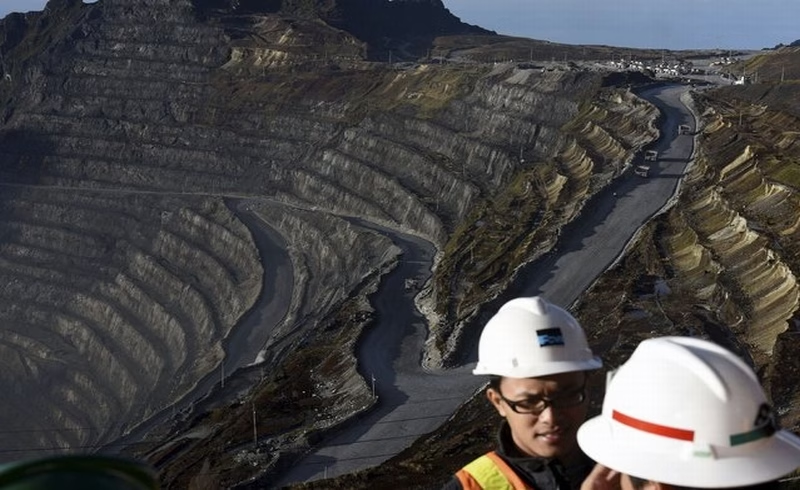
For the indigenous Kamoro people on the southern coast of Papua, rivers are more than just flowing water; they are the lifeblood and historic pathways bequeathed by their ancestors. Yet today, the Ajkwa Estuary is growing increasingly shallow, choked by mounds of toxic sediment. Every day, approximately 200,000 tons of mining tailings cascade into the Aghawagon and Otomona rivers, transforming a once-vibrant landscape into a dying zone.
Downstream, copper levels have skyrocketed to nearly 40 times above safe limits. The water’s acidity (pH) has plummeted to around 3.5—acidic enough to wipe out most aquatic life.
This is the heavy price of an exploitation that has dragged on for over five decades. And now, that suffering is officially slated to continue.
The Indonesian government recently struck an agreement to extend its Memorandum of Understanding (MoU) with the American mining giant, PT Freeport Indonesia (Freeport-McMoRan Inc.). This deal gives the corporation the green light to continue extracting copper and gold from Papuan soil until the very last vein of ore is depleted.
For policymakers in Jakarta, the extension is celebrated as a massive triumph for the investment climate and a promise of boosted state revenues. But for the Indonesian Forum for Environment (WALHI), the nation’s largest independent environmental organization, the decision reads like a death sentence for Papua’s ecosystems.
“This MoU is not merely an extension of operational time,” asserts Boy Jerry Even Sembiring, WALHI’s National Executive Director. “It actually erases any space for efforts to restore the Papuan ecosystems that have been ravaged for over 50 years. The state has shifted its role—from what should be the protector of the people, to a facilitator of an ecological disaster that threatens the very survival of indigenous communities.”
A Deal Behind Closed Doors
To the international community, the transition toward green energy is currently driving a massive global surge in copper demand. Yet here at the “ground zero” of extraction, the narrative of sustainability feels profoundly ironic and grim.
WALHI revealed that the drafting of the MoU—which serves as the basis for adjusting Freeport’s Special Mining Business License (IUPK)—was conducted behind closed doors. The process severely lacked transparency and, most heartbreakingly, entirely bypassed the voices and meaningful participation of indigenous Papuans, the rightful custodians of the land.
This unilateral decision effectively locks Papua into a renewed cycle of destruction. The rights of Native Papuans (OAP) have been sidelined to roll out the red carpet for the interests of a giant extractive corporation.
A Heavy Burden on Local Shoulders
The fallout from these boundless operations is not just a statistical footnote; it is a bitter reality that locals must breathe and endure every single day. Beyond the irreplaceable loss of thousands of hectares of tropical rainforest and the release of hundreds of thousands of tons of greenhouse gas emissions, creeping social and health crises are strangling local communities.
Traditional fishermen are crying out as their daily catches have plummeted by up to 60 percent, devastating their food security and family economies. Ashore, dust and pollution have triggered a sharp spike in Acute Respiratory Infections (ARI) in villages practically besieged by the mining area.
Without a binding and robust environmental recovery strategy, the extension of Freeport’s contract merely perpetuates an obsolete extractive economic model. It is a model that relentlessly drains natural wealth without ever guaranteeing a cure for the deep wounds it leaves behind.
Ultimately, this deal poses a crucial question to the world: must the future and survival of indigenous Papuans continue to be sacrificed to quench the global thirst for minerals? In the land of Papua, ecological injustice isn’t just allowed to happen; today, it has been granted an official permit to carry on.
- Traditional Dish Adds To Threats Facing Indonesia’s Carnivorous Plants

- The Blue Carbon Paradox: Indonesia’s Ecological Gamble on World Seagrass Day 2026
- West Java Besieged by Indonesia’s Deadliest Coal Power Plants
- Green Illusions: The Failing Promise of Indonesia’s Biomass Energy Plantations
- The Dark Shadow Behind the Copper Glint: Locking Papua’s Fate into Ecological Disaster
- Criminalized for Their Land: The Struggle of Sagea Residents Against Nickel Mining in North Maluku