
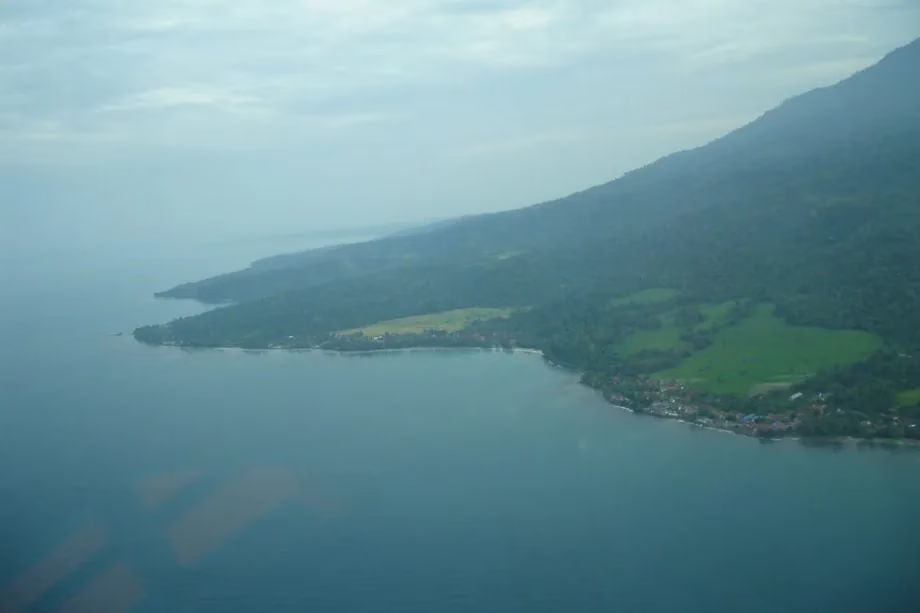
The Indonesian government has officially approved a significant geothermal power project in Telaga Ranu, Halmahera, North Maluku. While the move is a step toward the nation’s 2060 Net Zero Emission goal, it has ignited a firestorm of controversy due to the developer’s connections to Israel—a state with which Indonesia has no formal diplomatic relations.
The project will be managed by PT Ormat Geothermal Indonesia, a subsidiary of the Nevada-based Ormat Technologies. Despite its U.S. headquarters, Ormat is widely recognized for its deep historical and economic roots in Israel. The involvement of such a firm has placed Jakarta in a delicate position, balancing its urgent need for renewable energy investment against its long-standing and high-profile support for the Palestinian cause.
A Political Paradox
The permit for the Telaga Ranu Geothermal Working Area (WKP) was granted by the Ministry of Energy and Mineral Resources (ESDM) through Decree No. 8.K/EK.04/MEM.E/2026, dated January 8, 2026.
For decades, Indonesia has been one of the most vocal supporters of Palestinian independence on the global stage. This stance is not only a matter of foreign policy but also a constitutional mandate and a deeply resonant issue for the world’s most populous Muslim-majority nation.
The Middle East Monitor recently highlighted this contradiction, noting that while Indonesia presents itself as a staunch defender of Palestinian rights, the granting of energy concessions to a company with Israeli economic ties suggests a pragmatism that may undermine its international political standing. Critics argue that this move tests the consistency of Indonesia’s “free and active” foreign policy.
The Net Zero Ambition vs. Ecological Sensitivity
The Telaga Ranu project is a key component of Indonesia’s aggressive dekarbonization agenda. As part of its climate commitments, the government is looking to tap into its vast geothermal potential—the world’s largest—to replace coal-fired power plants.
However, the choice of location has raised environmental red flags. Halmahera is a region of high biodiversity and fragile forest ecosystems. While geothermal energy is often touted as a “clean” alternative with lower carbon emissions than fossil fuels, the infrastructure required for its extraction—such as access roads, heavy drilling rigs, transmission lines, and support facilities—poses a direct threat to local habitats.
Environmental advocacy groups, including WALHI (The Indonesian Forum for Environment) North Maluku, have long expressed concerns about industrial expansion in the province. They point out that more than 2 million hectares of land in the region have already been annexed by corporate interests, primarily for mining. There are fears that the Telaga Ranu project could further strain an already vulnerable ecological landscape.
Balancing Act
The Indonesian government now faces the challenge of justifying this partnership to both domestic and international observers. The investment is no longer viewed as a purely technical energy matter; it has become a litmus test for how the country balances its environmental survival with its geopolitical integrity.
Observers suggest that for the project to gain broader social and political acceptance, the government must ensure absolute transparency regarding the environmental impact assessments and demonstrate that this economic partnership does not signal a shift in its core diplomatic principles.
As the drilling begins in the lush forests of Halmahera, the eyes of the international community—and the Palestinian solidarity movement—will be watching closely to see how Jakarta navigates this complex intersection of green energy and global politics.
- An Urgent Plea for International Aid from the Heart of Indonesia’s Toxic Haze Crisis
- How the Savannas of Nusa Tenggara Became Indonesia’s New Epicenter for Land Fires
- Why World Mangrove Day Requires Action, Not Just Rhetoric?
- Fair Finance Asia Promotes Collaboration on Energy Transition
- The Smoke Crisis and Methane Time Bomb at Jatiwaringin Landfill
- One Year Since the Maba Sangaji Forest Tragedy