Mountains of vegetable scraps, fruit peels, and leaf clippings are commonly found in the corners of densely populated neighbourhoods in Gayamsari, Semarang. During the summer, the smell is pungent, attracting flies and making residents uncomfortable. However, this scene has slowly changed since residents began to learn how to utilize kitchen waste as a new resource.
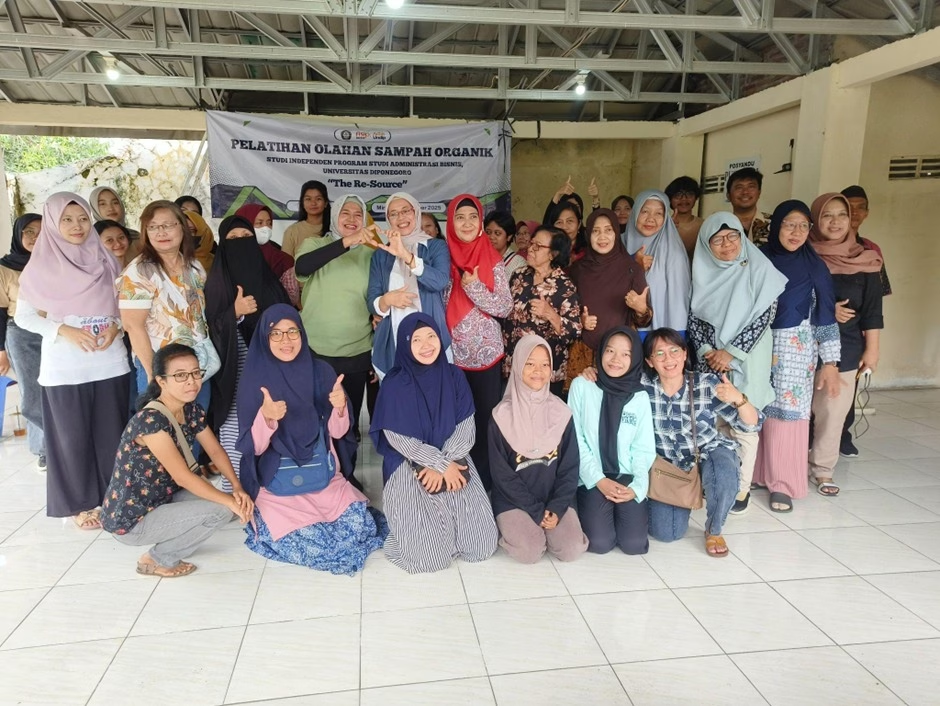
This change began on Sunday (October 26), when the Business Administration Study Program, Faculty of Social and Political Sciences, Diponegoro University, held a training session on organic waste processing at the Puspa Sari RW 04 Posyandu Building. The event, themed “The Resource: From Waste to New Life”, served as a learning space to reintroduce the idea that household waste, especially organic waste, can be processed and utilized directly, rather than ending up in landfills.
The training featured Dr Ir Cahya Setya Utama, S.Pt., M.Si., IPM, a lecturer at the Faculty of Animal and Agriculture, Undip, who has been studying household waste management. The material presented was not only in the form of lectures but also hands-on practice from the very beginning of the process, namely sorting.
Kitchen Waste That Has Been Thrown Away All This Time Can Actually Be a Blessing
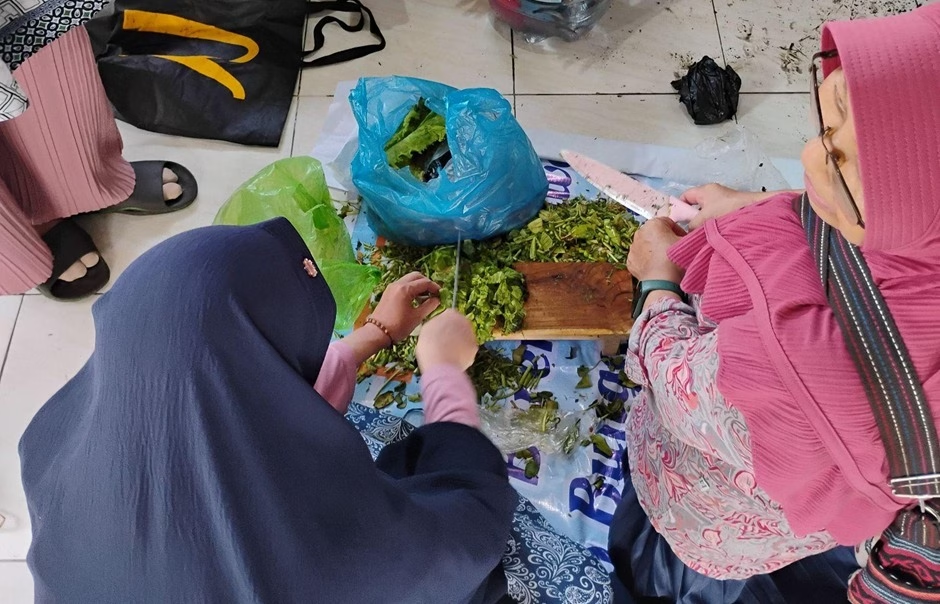
Approximately 45 participants were asked to bring organic waste from their homes, including vegetable scraps and fruit peels. Piles of plastic bags filled with kitchen scraps covered the practice tables. Unlike typical awareness-raising activities, participants not only listened to theory but also actively chopped, mixed, and fermented organic waste into compost.
“Household waste is not just any waste. We can turn it into something new and more useful, both as a form of environmental awareness and an economic opportunity. This is what we call turning waste into a blessing,” said Cahya when opening the session on Sunday (10/26/2025).
Participants were divided into several groups. They tried each step: sorting vegetable scraps, shredding materials, adding activators, and then storing them in closed containers for fermentation. With direct guidance, residents saw that the waste processing process was not as complicated as they had imagined.
This activity was a new experience for many participants. Some admitted that until now, organic waste had only been thrown into public trash bins without any prior sorting. The resulting odour was considered normal in a densely populated area.
However, after participating in the practice, residents began to see another side. Waste that was once considered garbage could actually return to the soil as fertilizer.
From Compost to Urban Farming: Food Grown in Your Backyard
The result of the composting process is not just fertilizer. Cahya explained that compost can be used as a medium for growing various vegetables and fruits, even in limited space.

This training introduced urban farming and hydroponics practices. With homemade compost, residents can grow vegetables in their yards, small pots, or whatever containers they have available. One participant, Mrs. Siti, admitted that she had just learnt that kitchen scraps could be used as natural fertilizer, rather than just waste that had to be thrown away.
“I just found out that kitchen scraps can be used as natural fertilizer. Now I want to try growing vegetables using homemade compost in my yard. That way, I can harvest anytime and save on grocery expenses,” said Mrs. Siti.
If this practice continues, not only will waste be reduced, but families can also save on kitchen expenses. In fact, the produce can be sold to supplement income.
When Residents Learn to Manage Their Own Waste
This training not only teaches composting techniques but also fosters new habits, such as sorting waste at the household level. Residents are beginning to understand that waste management does not have to wait for the existence of extensive facilities such as central waste banks or recycling plants.
With behavioural changes in the kitchen, the problem of waste accumulation can be reduced at the source. Foul odours and organic waste puddles can be reduced, the environment becomes cleaner, and residents’ health is better maintained.
In addition to environmental benefits, this training offers economic value. The compost produced can be used for personal consumption or sold. Meanwhile, produce from urban farming can serve as a source of food for households.
Cahya said that urban farming is not only about planting but also about independence.
“By planting fruits and vegetables at home, you can enjoy the produce yourself. You can control the quality. In addition, you can sell it to generate additional income.”
The Role of Higher Education: From Campus to Community
This activity demonstrates the role of higher education in community life. It extends beyond the classroom, reaching directly into the community and providing practical skills. Through practice-based learning, participants come to understand that household waste has value that can be converted into something beneficial.
This collaboration also demonstrates that change towards sustainability does not have to begin with large-scale projects. It can start with simple things: separating plastic from organic waste, processing kitchen scraps into compost, and using compost for planting. From daily habits, a new lifestyle is born, one that is cleaner, more economical, and more environmentally friendly.
Waste That Is No Longer Seen the Same Way
The organic waste management training in Gayamsari demonstrates that change can begin at one’s own home. With simple understanding and practices, residents realize that kitchen waste is not the end of the food cycle, but the beginning of a new cycle of reuse.
- Waste that used to rot now becomes compost.
- Compost that was once considered insignificant now serves as a valuable fertilizer for plants.
- The plants that grow then provide economic and food benefits for families.
This activity shows that waste solutions do not always require high technology. What is needed is knowledge, guidance, and the willingness to try.
From Gayamsari, a lesson emerges: sustainability can be built from the kitchen, from the backyard, and from small habits practised consistently. Residents are beginning to realize that waste management is not just about maintaining cleanliness but an investment in the future for the environment, families, and future generations.
- The Blue Carbon Paradox: Indonesia’s Ecological Gamble on World Seagrass Day 2026
- West Java Besieged by Indonesia’s Deadliest Coal Power Plants
- Green Illusions: The Failing Promise of Indonesia’s Biomass Energy Plantations
- The Dark Shadow Behind the Copper Glint: Locking Papua’s Fate into Ecological Disaster
- Criminalized for Their Land: The Struggle of Sagea Residents Against Nickel Mining in North Maluku
- Sulawesi Bear Cuscus Sightings: A Cry for Help from a Vanishing Habitat