
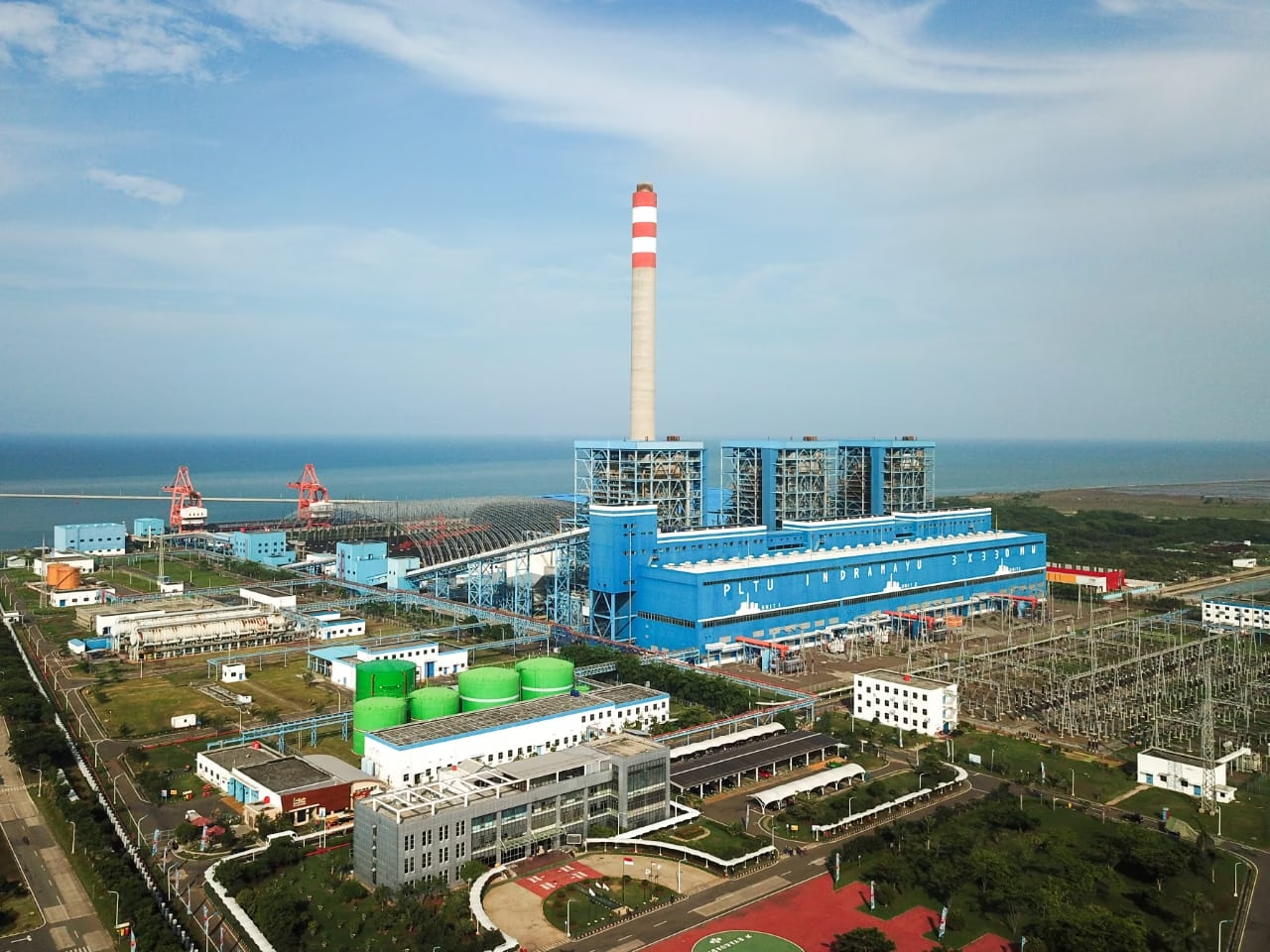
A new report titled Toxic Twenty: The Blacklist of the 20 Most Dangerous Coal Power Plants in Indonesia has identified West Java as the province suffering the deadliest impacts of coal-fired power plant emissions in the country.
Co-authored by the Centre for Research on Energy and Clean Air (CREA), the Center of Economic and Law Studies (CELIOS), and the environmental group Trend Asia, the report goes beyond merely ranking generation capacities. It quantifies the devastating health and economic tolls of coal-induced air pollution. On a national scale, emissions from Indonesia’s coal plants are projected to cause 156,000 cumulative premature deaths between 2026 and 2050, resulting in estimated economic losses of USD 109 billion.
The Blacklist in West Java
In West Java, three major facilities—the Cirebon, Pelabuhan Ratu, and Indramayu coal power plants—have made the blacklist. All three operate in coastal areas near densely populated settlements.
The Cirebon Power Plant (Units 1 and 2), with a total capacity of 1,584 MW, is a primary concern. Its first unit has been active since 2012, with the second following in 2023. According to the report, pollution from this facility is linked to 1,109 adult deaths and four deaths among children under five each year. Retiring just Unit 1 could prevent an estimated 6,400 pollution-related deaths.
In Sukabumi Regency, the 1,050 MW Pelabuhan Ratu Power Plant has been running a 5% biomass co-firing program since 2021. Despite this initiative, the Toxic 20 report reveals that the plant’s operations still contribute to 481 adult deaths and two child deaths annually due to air pollution.
Meanwhile, the 990 MW Indramayu Power Plant is linked to 336 adult deaths and one child death per year, primarily from respiratory infections. Past expansion plans for this facility faced fierce resistance and legal challenges from local residents citing severe health and environmental risks.
Combined, these three plants generate over 3,500 MW of power, underscoring a massive concentration of coal reliance in a single, highly populated province.
Direct Toll on Local Communities
The report also captures the ground-level reality of these facilities. In Pelabuhan Ratu and Indramayu, residents frequently report chronic coughing and skin irritation. Coastal fishermen in Cirebon and Indramayu point to damaged marine ecosystems, which have shrunk their catch areas and forced them to sail further out at higher operational costs.
Siti Hannah Alaydrus, Advocacy and Campaign Manager for WALHI (Friends of the Earth Indonesia) West Java, stated that the findings validate years of community grievances. The inclusion of Cirebon, Pelabuhan Ratu, and Indramayu on the deadliest blacklist, she argues, is no coincidence.
“The Toxic 20 findings on premature deaths and economic losses confirm that the suffering of citizens is not just an assumption, but a direct consequence of energy policies that ignore public safety,” Siti said in a statement.
Co-Firing and a Flawed Energy Transition
While the Indonesian government has promoted biomass co-firing as a key energy transition strategy, the report argues this approach fails to address the core issue. Deadly pollution persists, and reliance on coal remains largely unchanged.
Bayu Maulana Putra, Bioenergy Campaigner at Trend Asia, warned that co-firing could actually worsen social and ecological impacts. “This program broadens the scope of the damage. Besides poisoning and impoverishing communities near the plants, the development of energy plantation forests to supply biomass will exacerbate inequalities in community land access,” he explained.
Furthermore, the report criticizes the 2025–2060 National Electricity General Plan (RUKN), which retains large-capacity coal plants until 2060 and even opens the door for an additional 6.3 GW of new coal capacity. Advocates argue this directly contradicts the urgent need to cut emissions and protect public health.
“The lack of a clear roadmap for retiring coal plants, coupled with plans for new ones, will increasingly marginalize farmers and fishermen, pushing Indonesia to the brink of a multidimensional crisis,” said Novita Indri, Fossil Energy Campaigner at Trend Asia.
A true energy transition, advocates stress, is not just about swapping fuels—it is about public safety. For the people of West Java living in the shadow of these power plants, the devastating impacts are already a daily reality.
- West Java Besieged by Indonesia’s Deadliest Coal Power Plants
- Green Illusions: The Failing Promise of Indonesia’s Biomass Energy Plantations
- The Dark Shadow Behind the Copper Glint: Locking Papua’s Fate into Ecological Disaster
- Criminalized for Their Land: The Struggle of Sagea Residents Against Nickel Mining in North Maluku
- Sulawesi Bear Cuscus Sightings: A Cry for Help from a Vanishing Habitat

- Indonesia’s Energy Transition Sparks Geopolitical Debate Over Geothermal Project’s Israeli Ties