
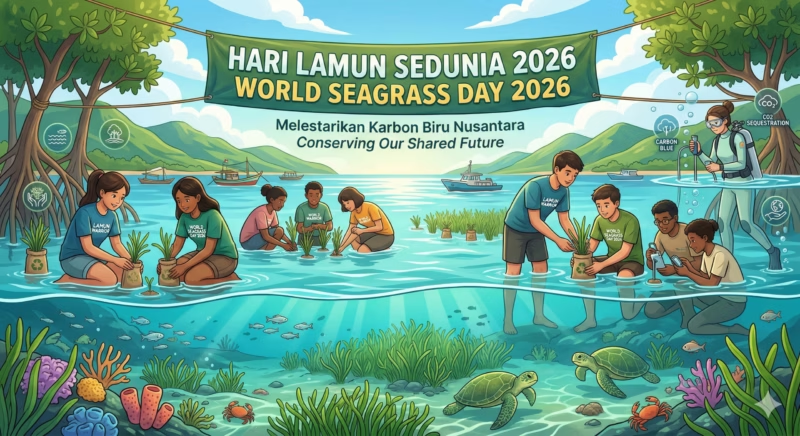
The global observance of World Seagrass Day 2026 on March 1 must no longer serve as a mere calendar ceremony that evaporates without meaningful policy impact. Officially established by the United Nations General Assembly through resolution A/RES/76/265, this momentum was born to break the long-standing marginalization of seagrass ecosystems.
For decades, these shallow-water habitats have been eclipsed by the visual allure of coral reefs and the dense canopies of mangrove forests. Yet, ecologically speaking, seagrass meadows operate as an unparalleled giant in providing essential environmental services.
These resilient underwater habitats act as the frontline defense against extreme storm surges, serve as critical nursery grounds for high-value fisheries, and function as a massive blue carbon absorption engine.
As globally emphasized by the United Nations Environment Programme (UNEP), seagrasses are among the most diverse and valuable ecosystems on the planet, playing an absolutely crucial role in combating climate change.
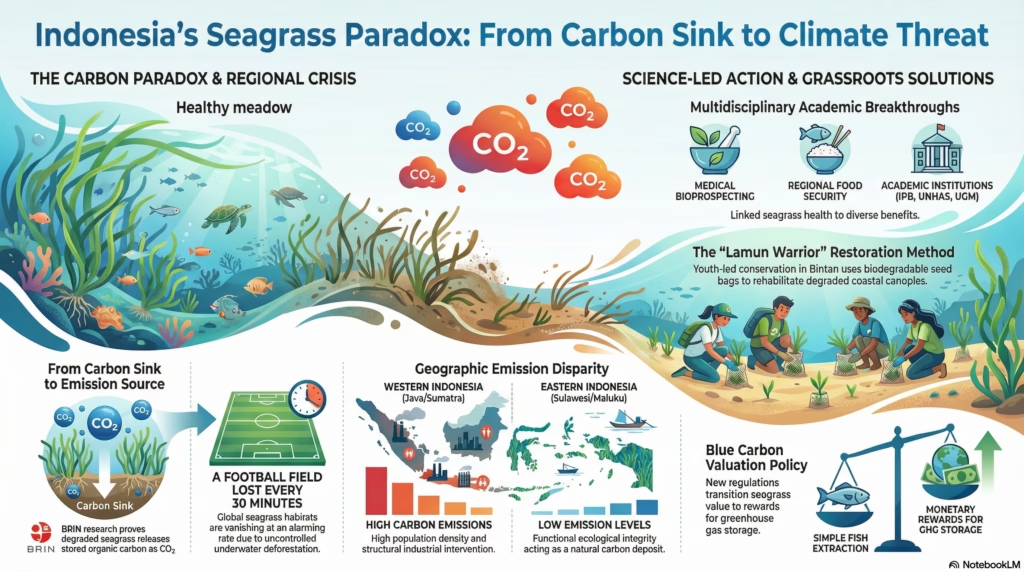
Unfortunately, this universal message now collides with a grim empirical reality. An area of seagrass the size of a football field is reported to vanish every thirty minutes worldwide, driven by unchecked underwater deforestation.
The Emission Threat from the Ocean Floor
In Indonesian waters, the threat of coastal habitat destruction opens a scientific Pandora’s box that demands immediate attention from state apparatuses and global climate negotiators. For years, our environmental mitigation discourse has been trapped in a methodological bias, heavily focused on calculating the ocean’s carbon absorption capacity while glaringly ignoring the emissions released from habitat destruction.
Monumental findings from Indonesia’s National Research and Innovation Agency (BRIN) completely overturn this flawed conventional assumption. Extensive research led by Principal Researcher A’an Johan Wahyudi proves that severely degraded seagrass ecosystems do not simply die; they invert their function to become active sources of carbon emissions into the atmosphere.
When the integrity of seagrass meadows is obliterated by shipping lane dredging, smothered by heavy sedimentation runoff, or crushed by massive coastal reclamation projects, its biomass suffers mass mortality. Cellular decomposition by microorganisms then dismantles the ancient organic carbon chains locked in the marine sediment, releasing them back into the water column as carbon dioxide.
Spatial modeling validates that the rate of carbon release due to seagrass destruction in the archipelago exhibits sharp geographic disparities. Coastal areas in western Indonesia, particularly the densely populated and heavily industrialized coastlines of Java and Sumatra, record high-level emissions due to severe anthropogenic pressures.
Conversely, waters in the central and eastern regions, such as Nusa Tenggara, Sulawesi, and Maluku, still maintain remarkably low emission thresholds. This reality indicates that the ecological integrity in the eastern archipelago remains functionally intact as a natural carbon sink.
Academic Synergy and Grassroots Action
Entering this year’s observance, seagrass ecosystems have evolved into a rich canvas for interdisciplinary science. Various leading national universities have contributed extraordinary blueprints of applied research, proving that marine habitat preservation is the lifeblood of multisectoral economies.
IPB University has successfully uncovered marine medical bioprospecting potential through extensive research by Prof. Dietriech G. Bengen, focusing on seagrass biodiversity and the discovery of antibacterial-producing symbiont bacteria in sea sponges associated with these meadows.
In the eastern hemisphere, Hasanuddin University (UNHAS), through comprehensive studies led by Prof. Rohani Ambo Rappe, has proven the absolute dependence of coastal communities on seagrass. Their research in Wakatobi and the Sulawesi coast highlights how gleaning fisheries serve as the backbone of food security for the country’s outermost regions.
Innovative technological leaps are also demonstrated by Universitas Gadjah Mada (UGM) alongside the Indonesian Biology Consortium led by Prof. Budi Setiadi Daryono. This leading collaboration pioneered high-precision underwater mapping methods, resulting in the historic discovery of dozens of new endemic taxa and species in the archipelago.
This ecological carrying capacity is further validated by empirical environmental engineering studies from Mahasaraswati University Denpasar and coastal ecology researchers from the University of Bangka Belitung (UBB). They factually recorded the massive carbon storage of seagrass biomass in coastal villages, which can reach tens of tons of carbon per hectare.
These brilliant academic achievements run parallel with the awakening of the state’s policy architecture. The enactment of national regulations regarding Carbon Economic Value means the valuation of seagrass is no longer just about how much fish can be extracted, but monetarily assessed for its service in storing greenhouse gases.
However, this grand policy architecture will never stand firm without a foundation of action driven by civil society. We must look to militant youth movements like the Lamun Warrior in Bintan Island, who independently transform the face of conservation by rehabilitating degraded coastal canopies using biodegradable seed bag methods.
The government is now urged to immediately execute advanced strategic steps by incorporating carbon leakage variables from marine sediments into the national greenhouse gas inventory system. Coastal spatial zoning maps must be strictly enforced, and a circular carbon market must be designed so that capital from high-emission companies flows directly to support grassroots coastal initiatives.
Ultimately, saving seagrass is not merely an act of defending a group of silent plants at the bottom of the ocean. This integrated effort is a paramount endeavor to defend the future of a coastal civilization that is climate-just, resilient, and sustainable.
- The Blue Carbon Paradox: Indonesia’s Ecological Gamble on World Seagrass Day 2026
- West Java Besieged by Indonesia’s Deadliest Coal Power Plants
- Green Illusions: The Failing Promise of Indonesia’s Biomass Energy Plantations
- The Dark Shadow Behind the Copper Glint: Locking Papua’s Fate into Ecological Disaster
- Criminalized for Their Land: The Struggle of Sagea Residents Against Nickel Mining in North Maluku
- Sulawesi Bear Cuscus Sightings: A Cry for Help from a Vanishing Habitat