

Mainstream media coverage of energy transition currently remains predominantly elitist. Media content is largely dominated by elite actors’ perspectives, resulting in public discourse becoming more exclusive and elite-oriented.
Remotivi Executive Director Yovantra Arief explains that media coverage of the climate crisis should focus on demanding accountability from those in power and amplifying silenced voices. This includes inspiring change and helping audiences understand the issues at hand.
“Media can shape awareness, foster social interaction to trigger engagement, and influence policy preferences. Climate and environmental issues also shape citizens’ political attitudes,” he said in Jakarta, as quoted on Saturday (11/30/2024).
Yovantra explains that elite discourse in media coverage primarily accommodates corporate and government elites. In his view, this indicates that media has lost its critical perspective on energy transition issues.
Based on Yovantra’s research, media coverage tends to resemble public relations content. Reports typically discuss government and private/state-owned company performance, covering aspects such as successful collaborations, funding, and investment achievements.
“Media also prioritizes coverage of energy project achievements or company commitments to energy transition from the sources’ perspective,” he explained.
This condition has led to diminishing citizen voices in news coverage. While energy transition is vital in responding to the climate crisis, he maintains that it must still be approached critically to ensure proper implementation.
“Media must examine the impacts of energy transition and highlight weaknesses in existing policies. Unfortunately, this rarely happens,” he clarified.
Therefore, Yovantra believes that participation based on partial information is inherently anti-democratic. This is because climate action mobilization is still based on incomplete knowledge.
“Relying solely on elite narratives without considering impacts on citizens will create false participation and weaken democracy,” he explained.
Yovantra recommends that mainstream media adopt a communication approach when covering conservation. This means not just writing, but providing comprehensive explanations, as policies must align with field experiences.
“Most audiences hold conservative values. To make people understand, you need to understand even better,” he concluded.
- Traditional Dish Adds To Threats Facing Indonesia’s Carnivorous Plants
 Nepenthes ampuralia, or pitcher plant, grows in the Lempur forest in Kerinci Regency, Jambi. This carnivorous plant is still used to wrap the traditional food lemang
 - The Blue Carbon Paradox: Indonesia’s Ecological Gamble on World Seagrass Day 2026
 The global observance of World Seagrass Day on March 1 must no longer serve as a mere calendar ceremony that evaporates without meaningful policy impact.
 - West Java Besieged by Indonesia’s Deadliest Coal Power Plants
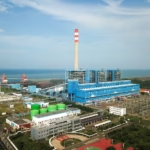 In West Java, three major facilities—the Cirebon, Pelabuhan Ratu, and Indramayu coal power plants—have made the blacklist.
 - Green Illusions: The Failing Promise of Indonesia’s Biomass Energy Plantations
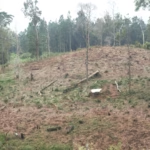 Energy Plantations project in Sukabumi stands at a crossroads. Caught between broken factory machines, failed calliandra saplings, and the citizens’ dread of losing their water sources.
 - The Dark Shadow Behind the Copper Glint: Locking Papua’s Fate into Ecological Disaster
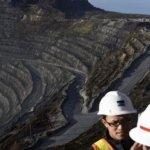 The Indonesian government recently struck an agreement to extend its Memorandum of Understanding (MoU) with the American mining giant, PT Freeport Indonesia (Freeport-McMoRan Inc.).
 - Criminalized for Their Land: The Struggle of Sagea Residents Against Nickel Mining in North Maluku
 Sagea residents face criminalization for protesting nickel mining projects that threaten their vital karst ecosystems and ancestral lands.