
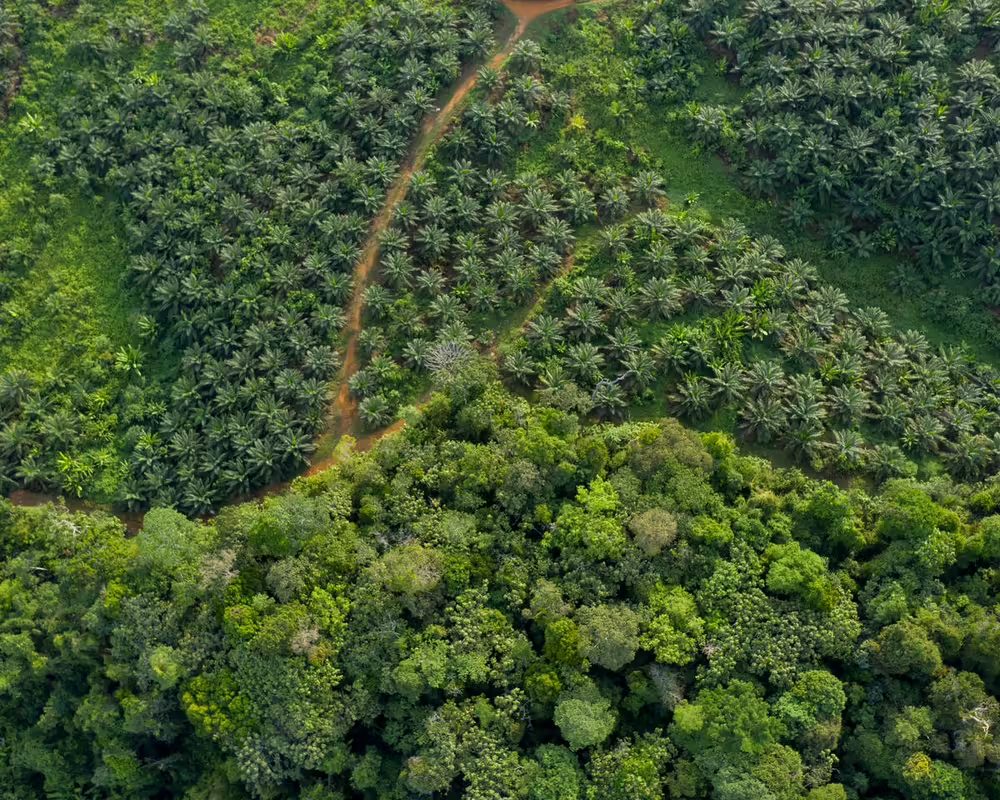
Fires, encroachment, and land conversion are the main triggers for deforestation and forest land degradation in West Kalimantan. Reduced forest cover results in decreased carbon absorption and increased emissions that have an impact on climate change.
This was revealed in the Socialization of Regent Regulation Number 70 of 2023 concerning Indicative Mapping and Management of High Conservation Value Areas (HCV) and High Carbon Stock Value Areas (SKT) in Other Use Areas. The socialization was held by the Sintang Regency Government, West Kalimantan, on April 2, 2024.
The enthusiasm for this socialization event was seen from the number of participants who filled the room, reaching 60 participants from district government agencies, sub-district governments, vertical agencies, land-based companies (oil palm plantations), and Development partners (CSOs) working in Sintang.
The socialization presentation session was opened by three speakers, namely: Rachmad Hafiz, a representative from WWF-Indonesia, Igor Nugroho, Head of the Sintang Regency Environmental Service, and Supomo, Head of the Spatial Planning and Land Service, Sintang Regency.
The Regional Secretary of Sintang Regency, Kartiyus, whose remarks were read by Igor Nugroho, Head of the Sintang Regency Environmental Service, said that protecting and preserving forests is an important step, but still paying attention to the need for land for agriculture and community development.
“Therefore, a strategy is needed that prioritizes sustainable development,” he said, accessed from the WWF Indonesia page, Sunday, August 4, 2024.
The Sintang Regency Government issued Regent Regulation Number 70 of 2023 as a policy instrument to support existing regulations and become a reference in formulating policies, programs, and planning for environmental governance and sustainable land use. This regulation is expected to be a mitigation instrument for wider environmental damage.
Signing of the Minutes of Handover of Integrated NKT-SKT Assessment Documents on a Landscape Scale by the Regional Secretary of Sintang Regency, October 20, 2023 at the Sintang Regency Environmental Service Office.
From the perspective of regional spatial planning, Supomo, Head of the Spatial Planning and Land Service, Sintang Regency explained the utilization of the NKT-SKT area in the region. He said that in Sintang Regency, six NKT (High Conservation Value) values and elements were identified. Protected areas and biodiversity (HCT 1), natural areas far from settlements (HCT 2), rare ecosystems and habitats (HCT 3), crucial ecosystem services such as water catchment areas (HCT 4), important sites for local communities (HCT 5), and traditional cultural sites (HCT 6).
Supomo also explained about Other Use Areas (APL) which are areas outside the state forest area that are designated for development activities outside the forestry sector or non-forestry cultivation. He emphasized the importance of mapping and utilizing the NKT-SKT areas in spatial planning in Sintang Regency in order to maintain environmental sustainability and sustainable development. Moreover, Sintang Regency is currently revising the Regency Spatial Plan. This NKT-SKT document will be very helpful in directing the determination of spatial patterns in the new RTRWK.
Rachmad Hafiz, a representative from WWF-Indonesia, presented the results of the NKT and SKT assessments on a landscape scale in Sintang Regency. Based on this assessment, the NKT area was identified as 1,168,526.17 ha (53.19%) and the SKT area as 978,134.93 ha (44.52%) of the total area of Sintang Regency which reached 2,196,895.71 ha. In the Other Use Area (APL), the NKT area was identified as 162,763.73 ha (7.41%) and the SKT area as 75,310.05 ha (3.43%).
After the presentations from the three speakers, the event continued with a response and input session from the participants. One of them was Mikhael Wiwinardi, the Head of Ambalau Sub-district, who said that Ambalau Sub-district is the largest sub-district with HCV-HCV areas in Sintang Regency, with 47.27% or 552,357.04 ha of HCV-HCV areas located in the sub-district.
Therefore, the Head of Ambalau Sub-district hopes that the HCV-HCV areas can have a positive impact on the people living in and around the area.
“Collaboration and participation are very much needed in the implementation of this Regent Regulation,” he said.
“Sub-districts and villages must get space in managing HCV-HCV areas. If possible, the form of sanctions also needs to be considered to be applied if violations occur.”
Albertus Tjiu, Arabela Landscape Manager – WWF-Indonesia, also expressed his optimism to protect and manage the HCV-HCV areas in Sintang Regency. He feels optimistic with the existing regulatory instruments and collaborative support from various parties in Sintang Regency.
“In the future, efforts to encourage collaboration or partnerships in managing NKT-SKT areas at the site level are key,” concluded Albertus Tjiu.
- Why World Mangrove Day Requires Action, Not Just Rhetoric?
 Honoring July 26 means remembering Hayhow Daniel Nanoto and all environmental defenders who sacrificed their lives for coastal ecosystems.
 - Fair Finance Asia Promotes Collaboration on Energy Transition
 As Geopolitical Crises Fuel Coal Rush, Fair Finance Asia Demands a Truly Just Energy Transition
 - The Smoke Crisis and Methane Time Bomb at Jatiwaringin Landfill
 The Jatiwaringin Landfill tragedy is a systemic waste management failure, not a natural accident
 - One Year Since the Maba Sangaji Forest Tragedy
 Eleven Maba Sangaji indigenous people were arrested during a ritual to reject mining in May 2025. A year later, the destructive power of mining had spread even further.
 - The Scent of Sustainability: How Sulawesi’s Farmers and Standing Forests are Redefining the Global Beauty Supply Chain
 The Scent of Sustainability emerges as ParagonCorp and Indonesian farmers unite to build a regenerative global beauty supply chain.
 - Indonesia’s Nickel Boom Is Flooding Indigenous Lands in North Maluku
 The criminalization of eleven members of the Maba Sangaji Indigenous community is a stark example of Strategic Lawsuits Against Public Participation (SLAPP). It reflects a calculated effort to silence grassroots resistance to forest destruction and river pollution linked to a nickel mining operation in North Maluku.
