The criminalization of eleven members of the Maba Sangaji Indigenous community is a stark example of Strategic Lawsuits Against Public Participation (SLAPP). It reflects a calculated effort to silence grassroots resistance to forest destruction and river pollution linked to a nickel mining operation in North Maluku.
Asia Lukman, 52, could not hold back her tears when the Sangaji River flooded her farm in late September 2025. The water—thick with deep red mud—swept across her land, burying her chili, tomato, and corn crops, and submerging her nutmeg and coconut trees.
“We never even got to enjoy the harvest,” Asia said quietly, recalling how her crops were destroyed just days before they were ready to be picked. “We cared for them for so long, and the flood wiped everything out. Only the nutmeg and coconuts survived.”
Heartbroken, Asia refuses to return to the farm. Even the thought of it tightens her chest. “My heart is broken. I don’t want to farm there anymore,” she said during an interview at her home in December 2025. Though she continues planting elsewhere, the anxiety lingers. “You keep planting, but the floods keep destroying everything. It’s exhausting.”
Her husband, Asis Bakir, guided us through what remains of their land. The scars of the flood are still clearly visible. Dried mud clings to the trunks of nutmeg and coconut trees, reaching up to knee height. Crops that were once lush and green now lie shriveled and dead.
On another plot, muddy water had even reached their parapara—a traditional rack used to dry copra. Three nutmeg trees died there, and twelve others were uprooted by the current.
“My wife doesn’t want to farm here anymore,” Asis said. They have since moved their daily work to their child’s land, about two kilometers from the village. It is still along the Sangaji River, but sits on slightly higher ground—safe, for now, from the muddy floods.
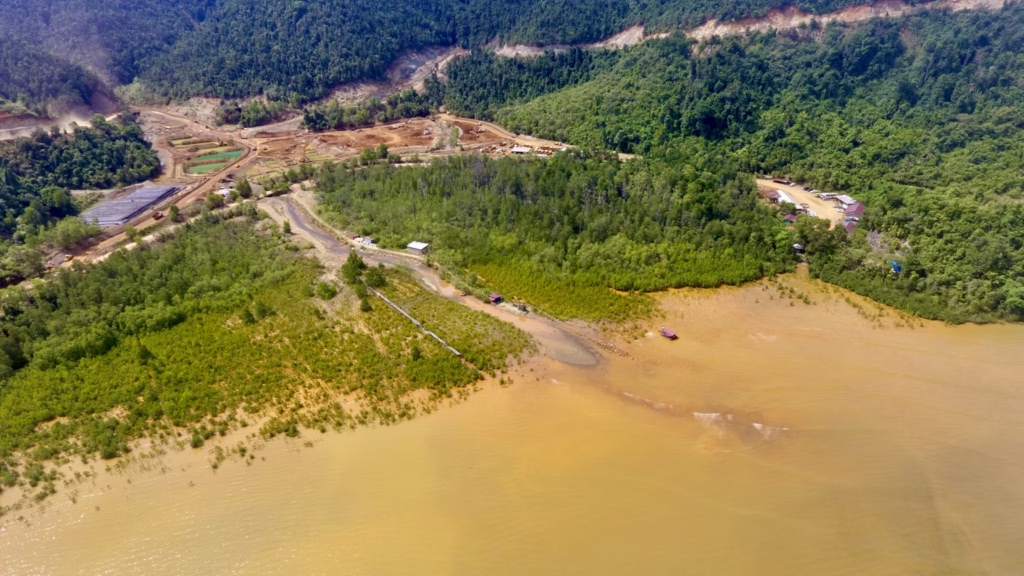
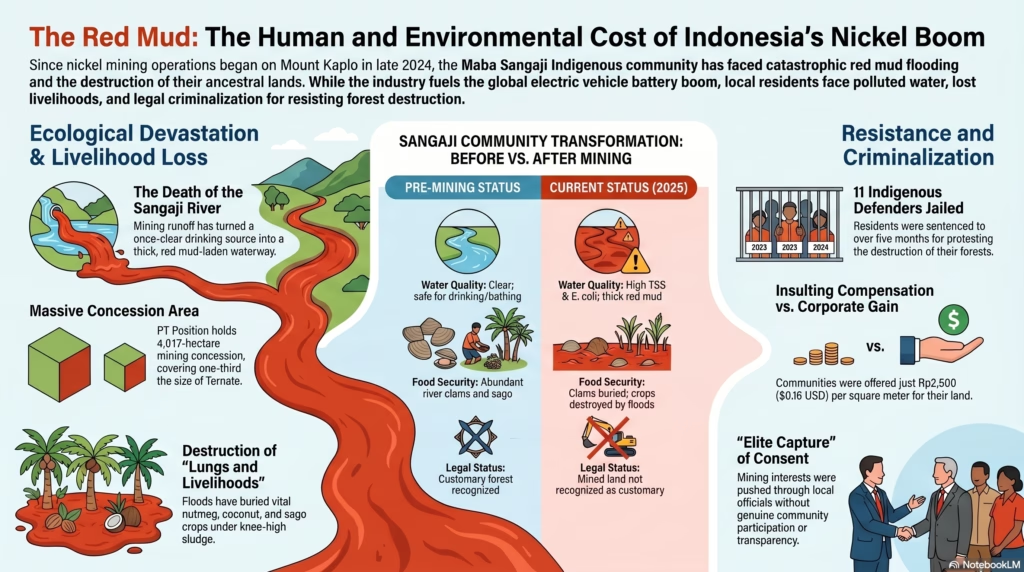
Flooding along the Sangaji River is not new, Asis explained. But it has never been like this. In the past, floods would carry only grass and loose soil from the riverbanks. Now, residents suspect that since nickel mining company PT Position began operating in late 2024, repeated floods laden with thick mud have devastated their farms. The river, once clear, now remains constantly murky.
“In the past, even after flooding, the water would clear up within a day,” Asis said. “Now, the floods bring heavy mud. And lately, it’s getting deeper—and redder.”
The Loss of a River’s Legacy
For the people of Maba Sangaji, the river carries centuries of memory. It was once the heart of daily life—a place where villagers gathered to bathe in the estuary, collect drinking water, wash clothes, process sago, and fish or gather clams (bia). Nature provided everything, freely.
Today, the river’s physical transformation has severed that long-standing cultural lifeline.
During our week-long visit in late December 2025, these traditions had all but disappeared. Residents now use the water only when its turbidity briefly subsides. A few still wade into the murky river to process sago, while children are forced to bathe farther downstream, near the estuary.
Asnia Salamuddin, 40, said the river’s current condition has stripped the community of a vital source of livelihood. The daily routine of gathering river clams has vanished. Instead of relying on the river beside their farms, women now have to carry bottled water from home.
“Since the mining company arrived, women here have stopped collecting clams from the river. They’re gone—buried under the mud,” Asnia said. “Before, we could drink straight from the river. We didn’t need to bring water to the farm. Now, no one dares to drink it. It’s all mud. Are we supposed to drink mud?”
The Sangaji River runs directly through Maba Sangaji Village in Kota Maba District, the administrative center of East Halmahera Regency, North Maluku. The village lies about six hours by road—roughly 231 kilometers—from the provincial capital.
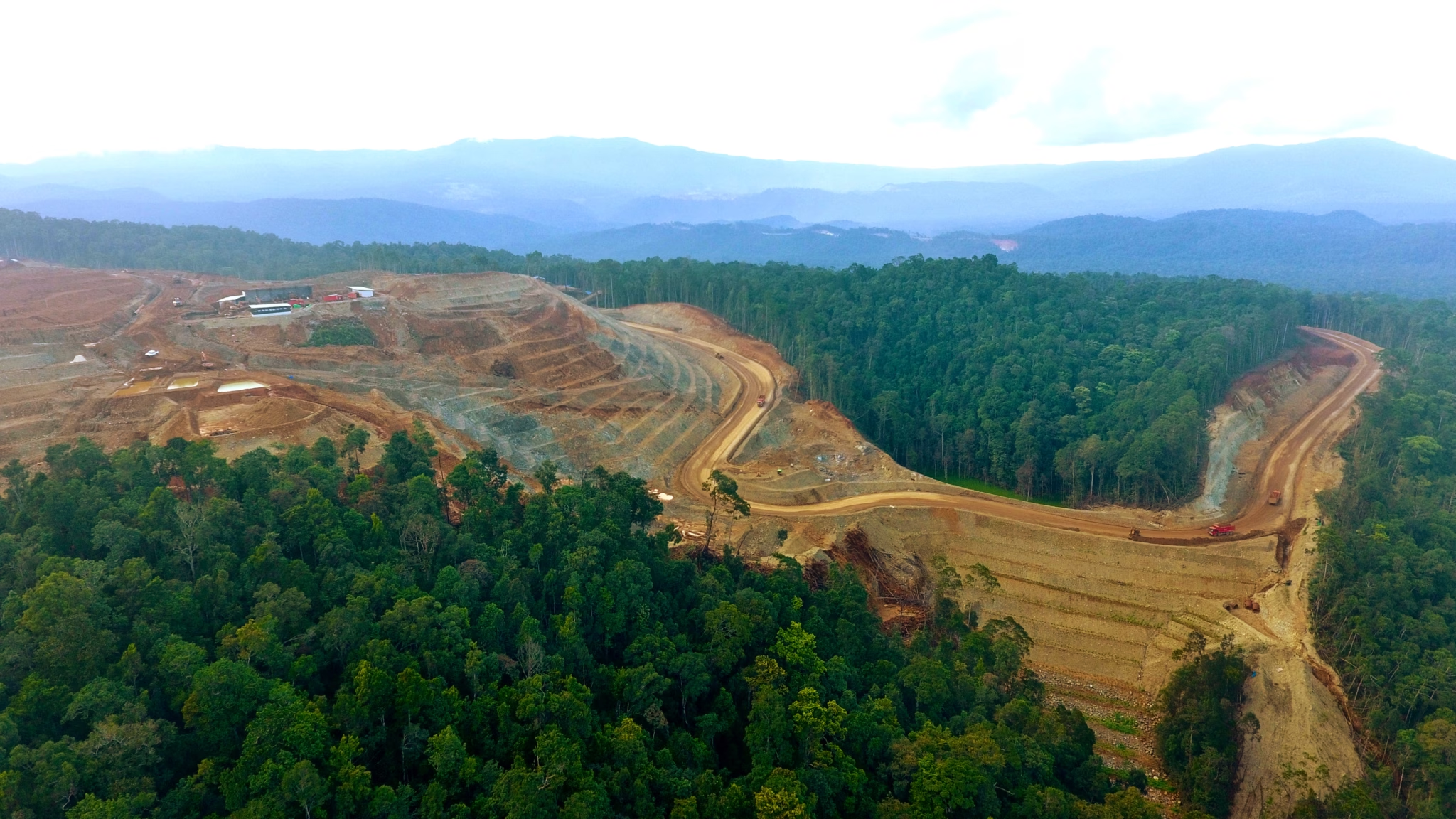
Nickel mining operations by PT Position are located on Mount Kaplo, deep within the customary territory of Maba Sangaji. The company holds a 4,017-hectare concession—about one-third the size of Ternate. Although it secured a production operation mining permit (IUP) valid from 2017 to 2037, active operations only began after it obtained a forest-use permit (PPKH) in October 2024. As land clearing and excavation intensified, runoff from the exposed soil is believed to have flowed into nearby tributaries and eventually into the Sangaji River.
Data from the East Halmahera Department of Environment show a clear decline in the river’s water quality between 2023 and 2025. Laboratory tests recorded sharp increases in Total Suspended Solids (TSS) and E. coli, indicating significant contamination. Yet residents were never informed of these findings.
The local government did not publicly disclose the test results. Meanwhile, the mining company sought to ease tensions by offering corporate social responsibility (CSR) programs, including the installation of clean water tanks.
For the people of Maba Sangaji, such gestures ring hollow. “We don’t need the company’s clean water,” Asnia said. “The Sangaji River used to be more than enough. They just need to stop operating so our water isn’t destroyed.”
Fighting for the Forest, Landing in Jail
The worsening ecological crisis pushed the Maba Sangaji Indigenous community to take to the streets in April and May 2025. But instead of halting mining activities in their ancestral forests, the state responded by arresting and jailing eleven residents.
Hawa Sinen, 52, spent those difficult months weaving traditional kalasa mats from sago palm fronds—her way of getting by while her husband, Umar Manado, was behind bars.
Umar was among the eleven Maba Sangaji men sentenced to five months and eight days in prison by the Soasio District Court on October 16, 2025. In its ruling, the court refused to recognize the mined area as part of the community’s customary forest. Instead, the Indigenous defenders were found guilty of “obstructing nickel mining activities” under Article 162 of the highly controversial Mineral and Coal Mining Law (Minerba).
The criminalization of Umar and the others began after devastating mud floods struck in late 2024. Suspecting upstream deforestation, residents staged a protest at the East Halmahera Regional Parliament (DPRD) in January 2025. At first, they suspected another company, PT Wana Kencana Mineral (WKM). But they later discovered that the large-scale land clearing behind the floods was carried out by PT Position.
After confirming the source of the damage, the community held an assembly with customary leaders and village officials. They firmly rejected the mining operations, stating that they had never given consent for their ancestral forest to be used.
Despite this, the company and the village government quietly reached a land acquisition agreement, offering a so-called “compensation fund” (tali asih) of just Rp2,500 (around $0.16 USD) per square meter. The deal only came to light when residents began planning a large-scale protest to shut down the mine.
Angered by the lack of transparency, dozens of Maba Sangaji residents marched to the Kaplo and Semlowos customary forests in mid-April 2025—areas considered sacred and historically significant. What they found was extensive destruction. Forests once filled with nutmeg, damar, agarwood, and medicinal plants had been reduced to barren land. Heavy machinery had torn through the hills, dumping soil into the watershed.
“We went there to ask the company to pause operations, come down to the village, and resolve this properly,” said Sahil Abubakar, a local youth. “They need to take responsibility for damaging the river and dividing our community.”
In an effort to force negotiations, Sahil and other residents seized the keys to 17 pieces of heavy equipment as leverage. Instead of opening dialogue, authorities responded by deploying armed police and military personnel.
Elite Capture and the Cost of Batteries
The conflict reflects a broader pattern in Indonesia’s mining sector: community consent is often sidelined through elite capture. On May 29, 2025—just days after the eleven Indigenous men were named suspects—the village governments of Maba Sangaji and Wailukum unilaterally accepted the first phase of the tali asih compensation, amounting to Rp5 billion and Rp4.5 billion, respectively. A second payment followed in August, coinciding with the first court hearing of the Indigenous defendants.
Julfikar Sangaji, a campaigner with the Mining Advocacy Network (Jatam) in North Maluku, said the flow of funds through village officials and local elites shows how corporate interests are often pushed through bureaucratic channels rather than built on genuine public participation.
“Situations like this shut the door on peaceful resolutions to administrative disputes and concession expansion on customary land,” Julfikar said. “When formal channels are blocked, grassroots resistance inevitably grows.”
The criminalization of the Maba Sangaji community—and the ecological damage they face—is just one chapter in a larger story unfolding in East Halmahera. As global demand for electric vehicle (EV) batteries fuels Indonesia’s nickel boom, the rapid accumulation of wealth stands in stark contrast to the polluted rivers and disrupted livelihoods of the Indigenous communities left behind.
- An Urgent Plea for International Aid from the Heart of Indonesia’s Toxic Haze Crisis
- How the Savannas of Nusa Tenggara Became Indonesia’s New Epicenter for Land Fires
- Why World Mangrove Day Requires Action, Not Just Rhetoric?

- Fair Finance Asia Promotes Collaboration on Energy Transition
- The Smoke Crisis and Methane Time Bomb at Jatiwaringin Landfill
- One Year Since the Maba Sangaji Forest Tragedy