
Deep in the remote village of Waluran Mandiri, Sukabumi, West Java, a magnificent 27-billion-rupiah (approx. $1.7 million) facility stands in silence amid a vast expanse of green. The biomass factory, owned by the state forestry company Perhutani, was supposed to be the beating heart of West Java’s grand energy transition—processing calliandra trees into a co-firing companion fuel for the Palabuhanratu coal power plant. Yet, as of August 2025, the machinery inside remains completely mute, leaving behind a stark irony hidden beneath the jargon of renewable energy.
From its inception, this Energy Plantation Forest (HTE) project was touted as a green solution. The target was ambitious: to produce 11,500 tons of biomass annually starting in the second quarter of 2025. Reality, however, has painted a different picture. During the trial phase, the main machinery—imported directly from China—suffered fatal malfunctions.
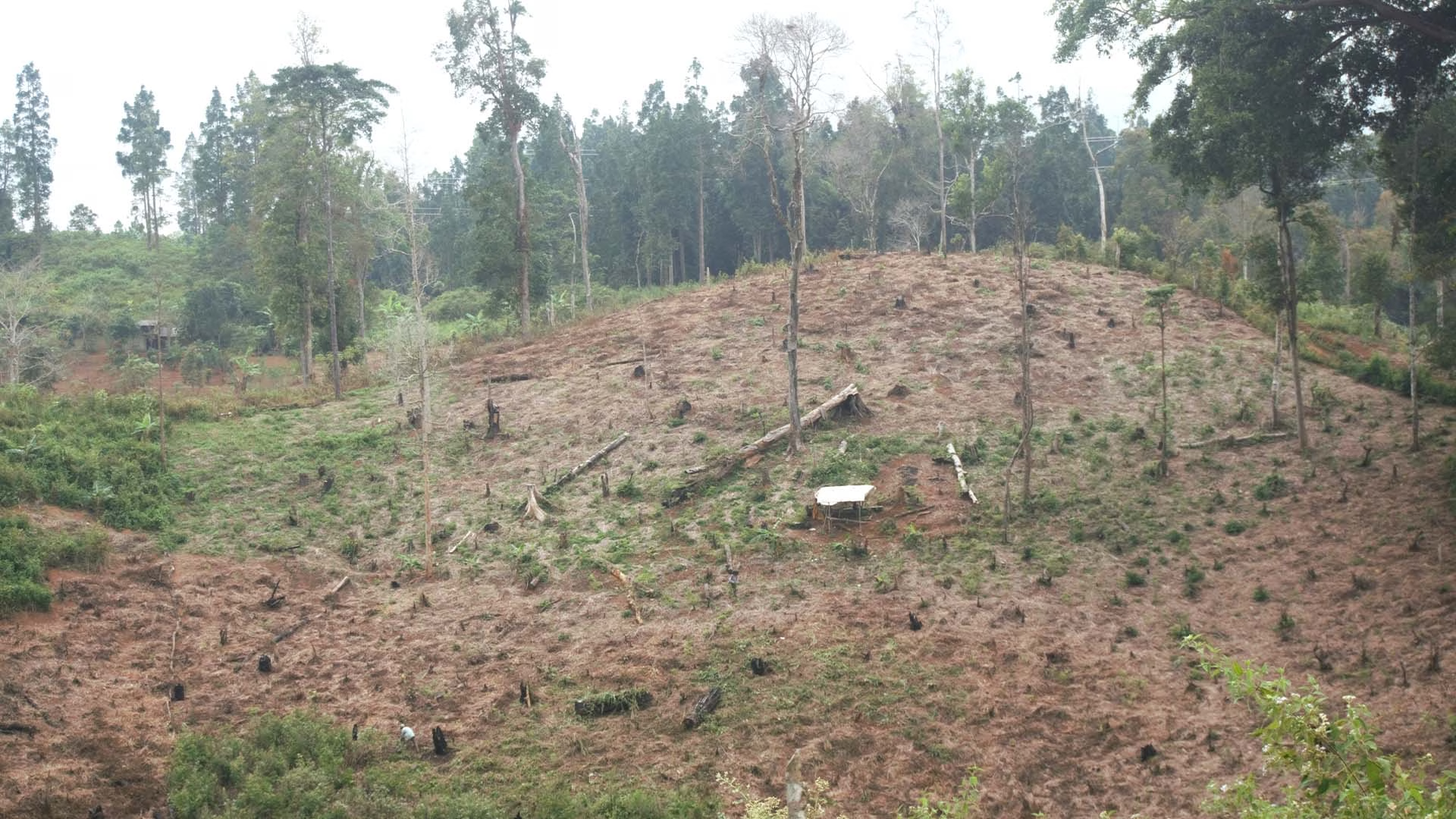
Consequently, mountains of processed-ready wood raw materials have become silent witnesses to this technical failure. Across 4,351 hectares of land, calliandra trees planted since 2019 were slated for harvest this year. The unreadiness of the supporting industry has sparked sharp criticism from environmental activists, who point to a glaring lack of maturity in the project’s planning.
Ecological Anxieties in the Heart of Sukabumi
Beyond the production figures lies the deep-seated anxiety of residents living around the West Hanjuang Forest, a crucial part of the UNESCO-recognized Ciletuh Palabuhanratu Geopark. For Fazri Mulyono, Head of the local forest village community institution (LMDH) Karya Bakti, the project is not a blessing but a looming threat to their future water security.
“I cannot imagine the sheer scale of the area that will be cleared when the calliandra harvest begins,” Fazri expressed with concern. The West Hanjuang Forest is more than just a collection of trees; it is the primary water catchment area for residents across the Waluran, Jampang Kulon, Ciracap, and Surade sub-districts.
Fazri’s fears are well-founded. With biomass production demands reaching up to 5 tons per hour, he doubts the forest’s sustainability if calliandra is continuously exploited on a massive scale. Furthermore, he discovered reports that the initial planting was executed haphazardly—using a “bulldoze” system without proper maintenance, resulting in many saplings failing to grow.
In response to the growing wave of resistance, Perhutani KPH Sukabumi has attempted to calm the situation. Bambang Bunyamin, the Head of Production and Ecotourism, guaranteed that the HTE project would not trigger deforestation. According to him, calliandra is an “eco-friendly” plant because it regenerates easily after being pruned—taking only a week for new shoots to emerge.
Perhutani also claims to have involved 22 local community institutions and hundreds of farmers in an empowerment scheme. They stated that 30 percent of the HTE land is permitted for residents to cultivate food crops and fruits, provided they do not plant vegetables that could damage the soil structure. However, for locals who have frequently witnessed formerly logged pine forests left un-reforested, these promises of a “sustainable forest” sound like a broken record.
The “False Solution” Behind Co-Firing
The issue becomes even more convoluted when the West Java chapter of the Indonesian Forum for Environment (Walhi) exposed what they describe as “environmental cosmetics.” The co-firing scheme—mixing biomass with coal—is criticized as a dishonest energy transition strategy.
Fauqi Muhtaromun from Walhi laid out the bitter facts: the use of biomass in coal power plants only ranges from 5 to 10 percent, while the remaining 90 percent is still dirty coal. “The claim of reducing emissions is simply untrue,” he asserted. Instead of cutting carbon, clearing forests to supply minimal biomass is viewed as creating a new carbon footprint.
More shockingly, Walhi found indications that the biomass produced in Sukabumi could potentially be sold to South Korea as an export commodity, rather than being used for national energy transition needs. If true, it means Sukabumi’s forests are being sacrificed not for the nation’s energy independence, but for mere commercial profit.
Waiting for Honesty Upstream of Ciletuh
Today, the HTE project in Sukabumi stands at a crossroads. Caught between broken factory machines, failed calliandra saplings, and the citizens’ dread of losing their water sources, the project requires much more than just mechanical repairs.
Anggi Putra Prayoga, a Campaigner for Forest Watch Indonesia (FWI), urges the government to conduct an immediate, comprehensive audit. Is this project truly a solution for the planet, or is it merely a new problem packaged under a “green” label? As long as coal remains the backbone of electricity and forests are continuously cleared for a token supply of biomass, this energy transition will remain nothing more than a mirage on the horizon of the Ciletuh Geopark.
- An Urgent Plea for International Aid from the Heart of Indonesia’s Toxic Haze Crisis
- How the Savannas of Nusa Tenggara Became Indonesia’s New Epicenter for Land Fires
- Why World Mangrove Day Requires Action, Not Just Rhetoric?

- Fair Finance Asia Promotes Collaboration on Energy Transition

- The Smoke Crisis and Methane Time Bomb at Jatiwaringin Landfill
- One Year Since the Maba Sangaji Forest Tragedy