
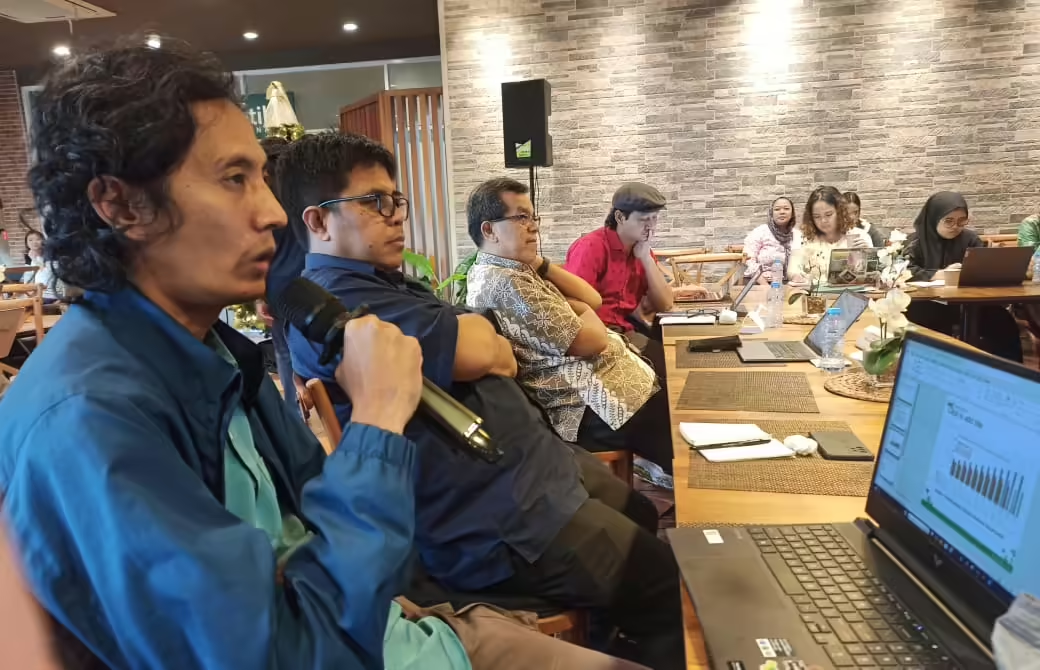
Attended directly by President Joko Widodo along with world leaders, the Just Energy Transition Partnership (JETP) project was officially launched on November 15, 2022 on the sidelines of the G20 meeting in Bali. A year later, the Comprehensive Investment and Policy Plan (CIPP) policy plan proposal was launched in Jakarta on November 21, 2023. But what is the current development?
Head of the JETP Indonesia Secretariat, Paul Butarbutar, revealed the nominal funding aspirations from JETP which were discussed at COP 29 in Baku, Azerbaijan, amounting to USD 1.3 trillion. However, the nominal that was later agreed upon was USD 300 billion. Of that amount, Indonesia received a share of USD 21.6 billion.
The provision of funds operated by JETP comes from funding from ten developed countries and international financial institutions. The JETP funds will target just energy transition projects in a number of developing countries. One of them is Indonesia.
“Why is JETP important? If it can be implemented properly, there will be opportunities for new workers. A survey from JETP regarding the construction of a 35-megawatt geothermal power plant requires 2,500-3,000 people over five years to create jobs,” he said in Jakarta quoted on Tuesday (10/12/2024).
The JETP Indonesia Secretariat also determined the investment focus areas (Investment Focus Area) starting from energy efficiency, electrification, transmission development, construction of new renewable energy (EBT) power plants, PLTU retirement and the EBT electricity supply chain.
He also revealed the reason Elon Musk did not invest, even though he had met former President Joko Widodo and former Coordinating Minister for Maritime Affairs and Investment Luhut Binsar Pandjaitan because Indonesia’s electricity sources still use fossil fuels as the main basis for energy generation.
“The results of the analysis launched last year agreed to limit carbon emissions from power plants connected to PLN to only 250 tons of carbon emissions in 2030. For that, a contribution of 44 percent of renewable energy is needed, then we will get a positive impact from the investment,” he explained.
Paul explained that currently the funding that has been approved by JETP is USD 1 billion in the form of loans and equity. The funds will target projects directly related to electrification and energy efficiency by involving domestic and foreign stakeholders.
Based on Paul’s observations, a number of energy efficiency activities require large costs. This condition makes banks reluctant to provide financing. Therefore, said Paul, it is hoped that developers or companies can take advantage of JETP funding. That way, it will also attract financing from banks.
“We are evaluating the purchase of 10 thousand buses for several of the largest cities. Including in Jakarta at a cost of USD 1 billion,” he said.
Access to funding for equitable energy transition projects
Paul hopes that projects with the JETP label can follow the nine standards that have been set. According to him, standards 1-8 have been used by all domestic and foreign banking institutions as a requirement for access to funding for equitable energy transition projects.
“While the ninth standard concerns economics and diversity,” he explained.
Meanwhile, regarding banking support, based on the regulations of the Financial Services Authority (OJK), a roadmap for sustainable financing has been issued. That way, banks can invest in green activities such as new and renewable energy (EBT).
“If you look at the financing of small-scale power plant projects under 10 megawatts, almost all use domestic banking money. Above that, it uses international banking,” he said.
Coordinator of Preparation of Energy Conservation Program, Directorate General of New, Renewable Energy, and Energy Conservation (EBTKE), Ministry of Energy and Mineral Resources (ESDM) Muhammad Arifuddin explained that his party encouraged JETP to help fund the Sustainable Renewable Energy (SRE) cooperation which also involved the community and students.
“We encourage JETP to help the government because the funds are limited so that assistance from stakeholders certainly encourages the development of EBT by involving the community,” he said.
In addition, said Arifuddin, other funding needed is regarding the need for the development of new renewable energy (EBT) in the regions. Based on calculations by the Ministry of ESDM, there is a need for 253 generating units in the form of hybrid power plants (PLTH), solar power plants (PLTS) and rooftop PLTS.
“In the waiting list for EBT development, there are currently 6.9 megawatts to electrify 13,350 families throughout Indonesia,” he said.
Afifuddin hopes that JETP funding will also target projects that provide direct benefits to the community in the form of grants. According to him, this is in accordance with Presidential Regulation Number 112 of 2022 concerning the Acceleration of Renewable Energy Development for Electricity Provision.
“In preparing this roadmap, one of the criteria that we added outside of what has been stipulated in Presidential Regulation 112 is the just transition aspect, both for workers who are laid off and the surrounding community who are affected,” he concluded.
- Indonesia’s Nickel Boom Is Flooding Indigenous Lands in North Maluku
 The criminalization of eleven members of the Maba Sangaji Indigenous community is a stark example of Strategic Lawsuits Against Public Participation (SLAPP). It reflects a calculated effort to silence grassroots resistance to forest destruction and river pollution linked to a nickel mining operation in North Maluku.
 - Coastal Voices on the Global Stage: A Semarang Fisherman’s Fight Against the Climate Crisis
 Ahmad Marzuki, a fisherman from Semarang, brought the voices of coastal communities to the global stage through his participation in the Global Citizens’ Assembly to advocate for food system justice and climate crisis solutions.
 - Breathing Kartini’s Spirit Beneath the Surface: The Role of Women Guarding Indonesia’s Marine Safety
 In commemoration of Kartini Day, the Indonesian Professional Women Divers Community (KP3I) emphasized the strategic role of women in the maritime sector through leadership in dive safety training in Labuan Bajo
 - Traditional Dish Adds To Threats Facing Indonesia’s Carnivorous Plants
 Nepenthes ampuralia, or pitcher plant, grows in the Lempur forest in Kerinci Regency, Jambi. This carnivorous plant is still used to wrap the traditional food lemang
 - The Blue Carbon Paradox: Indonesia’s Ecological Gamble on World Seagrass Day 2026
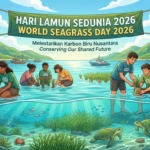 The global observance of World Seagrass Day on March 1 must no longer serve as a mere calendar ceremony that evaporates without meaningful policy impact.
 - West Java Besieged by Indonesia’s Deadliest Coal Power Plants
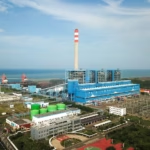 In West Java, three major facilities—the Cirebon, Pelabuhan Ratu, and Indramayu coal power plants—have made the blacklist.


