

Mainstream media coverage of energy transition currently remains predominantly elitist. Media content is largely dominated by elite actors’ perspectives, resulting in public discourse becoming more exclusive and elite-oriented.
Remotivi Executive Director Yovantra Arief explains that media coverage of the climate crisis should focus on demanding accountability from those in power and amplifying silenced voices. This includes inspiring change and helping audiences understand the issues at hand.
“Media can shape awareness, foster social interaction to trigger engagement, and influence policy preferences. Climate and environmental issues also shape citizens’ political attitudes,” he said in Jakarta, as quoted on Saturday (11/30/2024).
Yovantra explains that elite discourse in media coverage primarily accommodates corporate and government elites. In his view, this indicates that media has lost its critical perspective on energy transition issues.
Based on Yovantra’s research, media coverage tends to resemble public relations content. Reports typically discuss government and private/state-owned company performance, covering aspects such as successful collaborations, funding, and investment achievements.
“Media also prioritizes coverage of energy project achievements or company commitments to energy transition from the sources’ perspective,” he explained.
This condition has led to diminishing citizen voices in news coverage. While energy transition is vital in responding to the climate crisis, he maintains that it must still be approached critically to ensure proper implementation.
“Media must examine the impacts of energy transition and highlight weaknesses in existing policies. Unfortunately, this rarely happens,” he clarified.
Therefore, Yovantra believes that participation based on partial information is inherently anti-democratic. This is because climate action mobilization is still based on incomplete knowledge.
“Relying solely on elite narratives without considering impacts on citizens will create false participation and weaken democracy,” he explained.
Yovantra recommends that mainstream media adopt a communication approach when covering conservation. This means not just writing, but providing comprehensive explanations, as policies must align with field experiences.
“Most audiences hold conservative values. To make people understand, you need to understand even better,” he concluded.
- An Urgent Plea for International Aid from the Heart of Indonesia’s Toxic Haze Crisis
 Today, surrounded by an increasingly impenetrable haze, millions of lives are hanging on the hope of global solidarity.
 - How the Savannas of Nusa Tenggara Became Indonesia’s New Epicenter for Land Fires
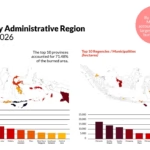 A recent analysis by MapBiomas Fire, NTT recorded the largest total burned area of any province in Indonesia between January and June 2026.
 - Why World Mangrove Day Requires Action, Not Just Rhetoric?
 Honoring July 26 means remembering Hayhow Daniel Nanoto and all environmental defenders who sacrificed their lives for coastal ecosystems.
 - Fair Finance Asia Promotes Collaboration on Energy Transition
 As Geopolitical Crises Fuel Coal Rush, Fair Finance Asia Demands a Truly Just Energy Transition
 - The Smoke Crisis and Methane Time Bomb at Jatiwaringin Landfill
 The Jatiwaringin Landfill tragedy is a systemic waste management failure, not a natural accident
 - One Year Since the Maba Sangaji Forest Tragedy
 Eleven Maba Sangaji indigenous people were arrested during a ritual to reject mining in May 2025. A year later, the destructive power of mining had spread even further.