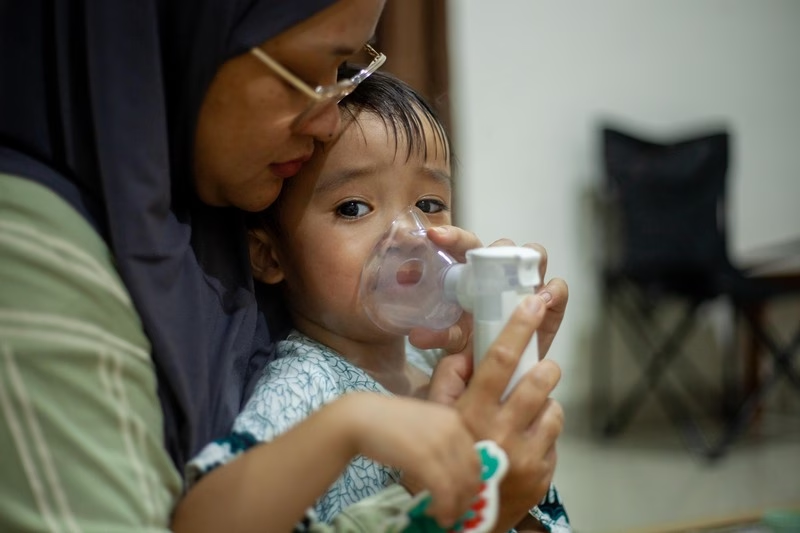
The air across vast swathes of Indonesia has ceased to be a source of life; it has become a creeping poison. The thick, acrid smog currently suffocating eight provinces is not merely reducing visibility—it is systematically devastating the health of millions trapped beneath it. In West Kalimantan alone, the grim reality is reflected in staggering numbers, with more than 165,747 people collapsing from Acute Respiratory Infections.
They are the visible victims among the 37.9 million citizens nationwide who are currently enduring a lethal crisis driven by the relentless forest and peatland fires tearing through the country in early September 2026.
For children, the elderly, pregnant women, and those with underlying health conditions, this toxic haze is a daily torment. The most fundamental human right—the right to breathe clean air and live in a safe environment—has been forcibly stripped away. This tragedy elevates the fires from a routine seasonal ecological disaster to a severe humanitarian crisis, a failure of public policy, and a gross violation of human rights that is allowed to repeat year after year.
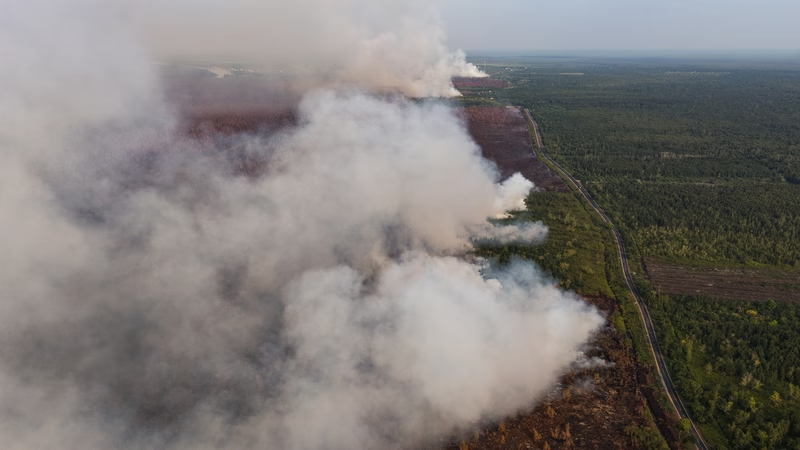
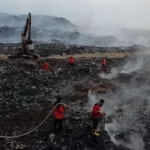
in Kapur Village, Kubu Raya Regency, West Kalimantan. [Photo: Victor Fidelis Sentosa – Trend Asia]
The horror unfolding on the ground is backed by deeply alarming data. Official reports from the Ministry of Forestry’s Early Warning System (SiPongi) reveal that between January and June 2026 alone, an estimated 202,010.96 hectares of land have been reduced to ash. This represents a brutal 366 percent spike compared to the same period last year.
The massive scale of these infernos has even ignited a regional diplomatic and environmental crisis, as the toxic smoke crosses international borders to blanket the skies of Singapore, Malaysia, Thailand, and the Philippines.
A dark irony lies beneath these burning peatlands. Operating atop the smoldering earth are industrial giants from the palm oil, pulp and paper, mining, and forestry sectors. Data analyzed from the Central Bureau of Statistics (BPS) spanning 2024 to July 2026 highlights that these very lands are the source of at least 11 global commodities, which are exported to and consumed by 169 countries worldwide. Yet, while transnational corporations and global supply chains reap massive profits, local civil society and wildlife are forced to pay the ultimate price.
According to Mapbiomas Indonesia Fire, this year’s crisis has also incinerated 11,442 hectares of crucial habitat for iconic and endangered species, wiping out high-value ecosystems and leaving rare wildlife with nowhere to run.
Amidst this escalating terror, the state’s absence is glaringly apparent. The Indonesian government is failing in its fundamental duty to prevent recurrent fires, rapidly extinguish the flames, and protect its citizens. For too long, the benchmark for handling these fires has been confined to statistical reductions of hotspots on paper, blatantly ignoring the public’s right to adequate healthcare, safe smoke-free shelters, and fair compensation for their suffering.
This systemic failure is compounded by deeply skewed law enforcement. The state possesses the apparatus, budget, and technological means to break this deadly cycle, yet it appears powerless against corporate capital. Small-scale farmers and indigenous communities living near the forests are routinely scapegoated and criminalized, while the powerful corporations that control millions of hectares and reap the economic windfalls of this land exploitation remain virtually untouched by any meaningful legal sanctions.
Facing systemic paralysis at home, a coalition of civil society organizations united under the Public Solidarity Initiative Against Forest Fire Haze (ISPA)—which includes Trend Asia, Greenpeace, Auriga, YLBHI, various regional chapters of Walhi, LBH Samarinda, and the Indonesian Environmental Law Advisors—has chosen to sound the alarm globally.
They are urgently demanding that United Nations agencies, international humanitarian organizations, and foreign governments step in to provide the emergency relief that the Indonesian government has failed to deliver.
The coalition is calling for the immediate deployment of critical medical supplies, including oxygen tanks, protective masks, and medicines, alongside the establishment of clean-air evacuation centers for vulnerable groups. Furthermore, they are demanding international assistance to rescue endangered wildlife, such as orangutans, as well as the deployment of advanced firefighting technology, water-bombing aircraft, and international experts to rapidly suppress the peatland fires.
The intolerable nature of this crisis was articulated sharply by Belgis Habiba, a representative of Greenpeace Indonesia speaking on behalf of the ISPA coalition. She emphasized that reaching out to the international community was a necessary step born out of domestic deadlocks.
“We do not want the Indonesian people to be continuously forced to inhale this deadly smoke while the state blatantly fails to provide basic protection, and the responsible corporations remain untouched by the law,” asserted Belgis Habiba. “This has escalated into a full-blown humanitarian and human rights emergency. We are calling for global solidarity and concrete international action right now, before more lives are lost to this negligence.”
Today, surrounded by an increasingly impenetrable haze, millions of lives are hanging on the hope of global solidarity. Waiting for the government’s promises of law enforcement is no longer enough to bring back the clean air that is rightfully theirs. The call for emergency aid is now a desperate race to save lives from the toxic fallout of corporate greed.
- An Urgent Plea for International Aid from the Heart of Indonesia’s Toxic Haze Crisis
- How the Savannas of Nusa Tenggara Became Indonesia’s New Epicenter for Land Fires
- Why World Mangrove Day Requires Action, Not Just Rhetoric?

- Fair Finance Asia Promotes Collaboration on Energy Transition

- The Smoke Crisis and Methane Time Bomb at Jatiwaringin Landfill
- One Year Since the Maba Sangaji Forest Tragedy