As geopolitical tension ripples across West Asia, the fractures in Asia’s heavy reliance on fossil fuels are widening. In a scramble for immediate energy security, countries like Indonesia have begun ramping up coal consumption to offset supply disruptions. Yet, behind the closed doors of Jakarta’s high-profile meeting rooms, a different narrative is taking root—one that warns against repeating the catastrophic environmental and social blunders of the past.
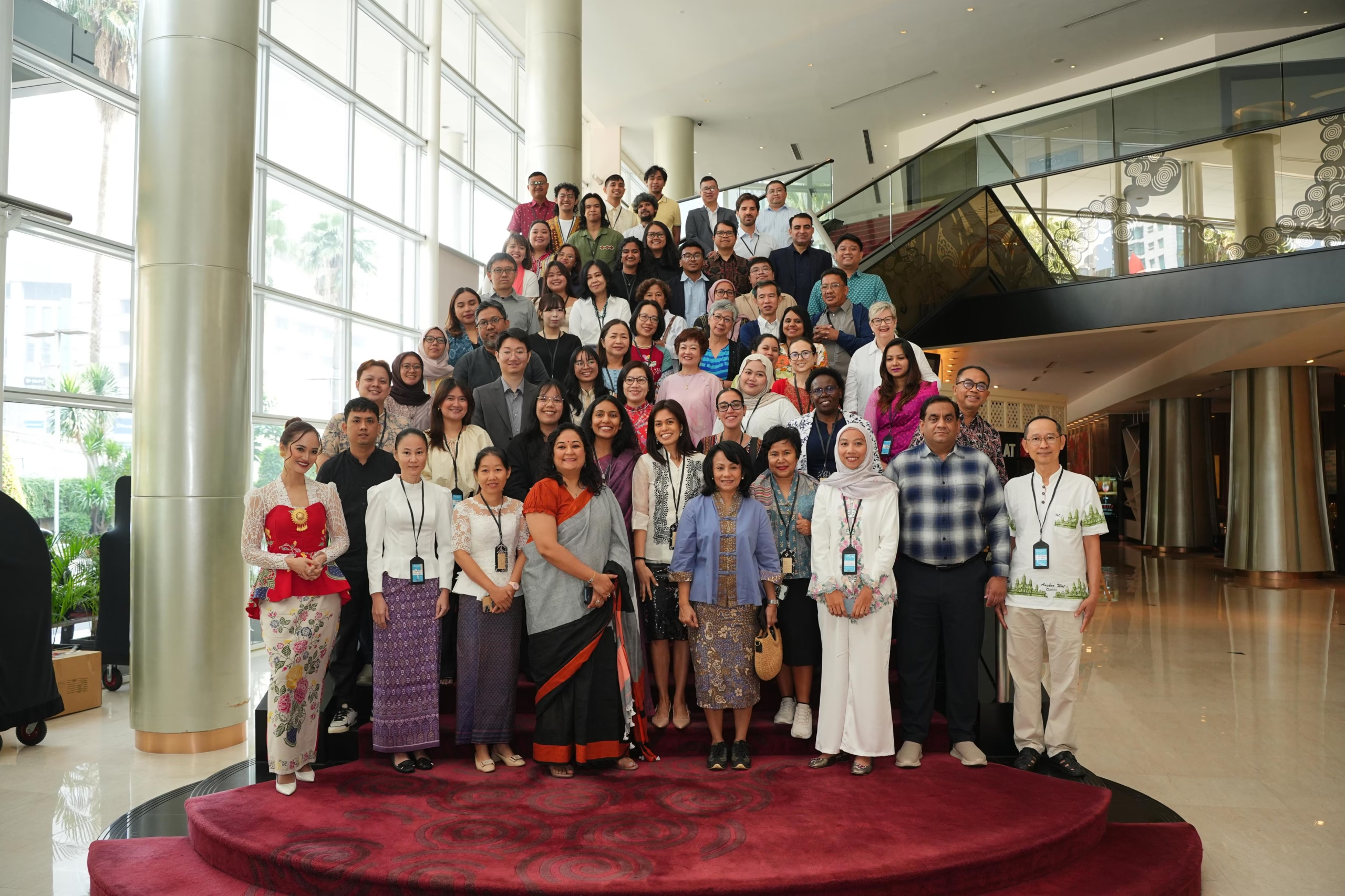
Over 90 civil society organizations (CSOs) from across the continent, united under the Fair Finance Asia (FFA) network, gathered alongside researchers, advocates, and local community representatives for the network’s 2026 General Assembly (GA) in Jakarta. Co-hosted by ResponsiBank Indonesia, the week-long assembly has transformed into a critical platform, issuing an urgent call to action for Asian financial institutions, regulators, and governments: stop the flow of capital to fossil fuels, close trans-border policy loopholes, and build a truly just energy transition.
The Illusions of the Green Rush
For resource-rich nations in Southeast Asia, the global pivot toward green energy is triggering a new kind of gold rush—this time, for critical minerals.
“Indonesia sits at the center of the challenges,” said Victoria Fanggidae, Executive Director of the think-tank PRAKARSA. As the world’s largest nickel producer and one of Asia’s most coal-dependent economies, Indonesia has become the ultimate testing ground for whether a “just transition” can exist in reality, or if it remains merely a corporate catchphrase.
“The rush for critical minerals cannot repeat the mistakes of the coal era,” Fanggidae warned. “If communities living alongside mining and processing sites are not recognized as equal partners, and do not see a fair share of the benefits, we will simply be trading one form of extraction and inequality for another.”
The warnings are backed by data. To challenge existing financial frameworks, FFA launched a series of flagship reports during the assembly targeting the deep systemic vulnerabilities across Asian supply chains:
- Phasing out Coal, Phasing in Justice: A regional roadmap detailing responsible pathways for financing a coal phase-out.
- Extraction to Equity: An extensive look into equitable governance and human rights compliance within Asia’s critical minerals value chains.
- Empowering Consumers as Partners in Sustainability: A collection of case studies analyzing financial regulation gaps.
- Why Inequality Matters in Asia: A study on how flawed financial governance directly exacerbates climate and economic risks.
The Invisible Balances
While macroeconomists debate transition pathways in terms of gigawatts and GDP, the actual toll of the energy landscape is felt most acutely by those left completely outside the decision-making rooms.
Farida Indriani, representing the National Presidium of the Indonesia Women Coalition (KPI), emphasized that the ecological collapse of mining areas bears a distinct gendered reality.
“Women in coal- and mining-affected areas carry burdens that rarely appear in project balance sheets: contaminated water, damaged health, lost livelihoods, and the unpaid care work that multiplies when a local environment collapses,” Indriani stated bluntly.
Despite carrying the weight of these externalized costs, women and Indigenous Peoples remain systemic ghosts at the negotiating tables. “A just transition that ignores half the affected population is not equitable,” Indriani added, demanding that benefit-sharing, consultation, and grievance mechanisms be gender-responsive from the very beginning.
Bridging the Cross-Border Policy Gap
The network stresses that local resistance and piecemeal national policies will not suffice if regional capital continues to flow unrestricted into polluting industries.
“Asia is at a crossroads,” said Bernadette Victorio, Program Lead for Fair Finance Asia. She noted that the current West Asian conflict has laid bare how fragile the region’s energy architecture truly is. “Stronger coordination between financial institutions, regulators, governments, and civil society across the region is urgently needed to close loopholes that continue to enable fossil fuel financing.”
For the FFA network—which spans coalitions across 10 countries including Bangladesh, Cambodia, India, Indonesia, Japan, Lao PDR, Pakistan, the Philippines, Thailand, and Vietnam—the message for the financial sector is clear: the energy gap cannot be bridged by sacrificing human rights and ecological stability. True energy resilience will depend entirely on whether the region’s capital can be steered away from extraction and toward an equitable, rights-based future.
- An Urgent Plea for International Aid from the Heart of Indonesia’s Toxic Haze Crisis

- How the Savannas of Nusa Tenggara Became Indonesia’s New Epicenter for Land Fires
- Why World Mangrove Day Requires Action, Not Just Rhetoric?

- Fair Finance Asia Promotes Collaboration on Energy Transition
- The Smoke Crisis and Methane Time Bomb at Jatiwaringin Landfill
- One Year Since the Maba Sangaji Forest Tragedy