Beneath the dense canopy of the Maba Sangaji forest, Umar Manado’s voice shattered the silence. The 68-year-old man’s hands gripped the base of the kabasarang (traditional) flagpole with unwavering resolve. As a kapita darat—a customary title bestowed upon the frontline guardian of the forests and rivers—he was chanting a bobeto, an ancestral mantra designed to ward off catastrophe.
Surrounding him, 26 villagers huddled close, anchoring themselves to the same wooden pole. The air that day was heavy with a magical tension. They cried out to the universe: “Taita embecen na agoom to… maggotol simpop, bom fi motsi…”—a fierce curse and a protective prayer demanding that anyone who came to destroy their land, be it corporations, state apparatus, or traitors, would be choked into oblivion.
But before the mantra could reach its crescendo, the ambush hit like a sudden storm. Police officers abruptly tackled Umar, twisting his arms behind his back. One by one, the farmers who were peacefully tending to their spiritual bond with nature were violently taken down. Calloused hands that typically wielded farming machetes were suddenly clamped in iron shackles.
On that day, May 18, 2025, a ritual meant to protect the indigenous forest in the heart of East Halmahera from the encroaching heavy machinery of a nickel mine was forcibly disbanded. A total of 27 villagers were dragged off to the North Maluku Regional Police headquarters in Ternate.
Exactly one year later, the wounds from that day remain open. Eleven of the arrested men were eventually sent to prison, while back in their village, the environmental devastation has only accelerated. The forest from which they were violently removed is now stripped bare. The heavy machinery won.
The Disaster Flowing into the Sangaji River
Maba Sangaji is more than just an administrative dot located six hours by land from the provincial capital of North Maluku. In this village, humanity does not separate itself from the forest and the water. They are the womb of life and a sacred spiritual sanctuary.
However, since late 2024, that ecological pulse has been severely choked. The indigenous forest is being steadily deforested. The Sangaji River, which once flowed crystal clear, now turns into a thick, muddy sludge every time it rains. Women have lost their traditional foraging grounds for bia (river clams). The villagers’ agricultural plots are being buried under mining runoff, slowly killing their crops.
The culprit only became known to the villagers later: PT Position. This nickel mining company secured a Mining Business License (IUP) covering 4,017 hectares, an area that directly overlaps with the villagers’ sacred lands and traditional hunting grounds. This massive concession was issued without the consent—or even the knowledge—of the people who breathe life into that land.
When company representatives finally arrived in the village in December 2024, they did not bring dialogue. Instead, they offered unilateral financial compensation and low-paying manual labor jobs. Naturally, the villagers rejected the offer outright. The people of Maba Sangaji do not need jobs from the very hands that are destroying their source of life.
Repeated rejections were ignored. The villagers’ patience reached its boiling point in mid-May 2025. For three days, they set up tents and banners at the company’s camp construction site, waiting in good faith for a dialogue. Instead of management representatives, they were met by a deployment of police officers tasked with crushing their traditional ritual.
Justice Defeated by a Mining Permit
Of the 27 villagers arrested, 16 were released the next day. However, the remaining 11 faced draconian legal snares. The police quickly labeled their peaceful forest protection ritual as acts of “thuggery.”
These ordinary men were hit with multiple charges: from carrying bladed weapons (under the 1951 Emergency Law, completely ignoring that machetes are standard farming tools), obstructing mining activities (Article 162 of the Mining Law), to extortion and making threats (under the Criminal Code). Those who were merely defending their right to a living space were forced to sit in the defendant’s chair.
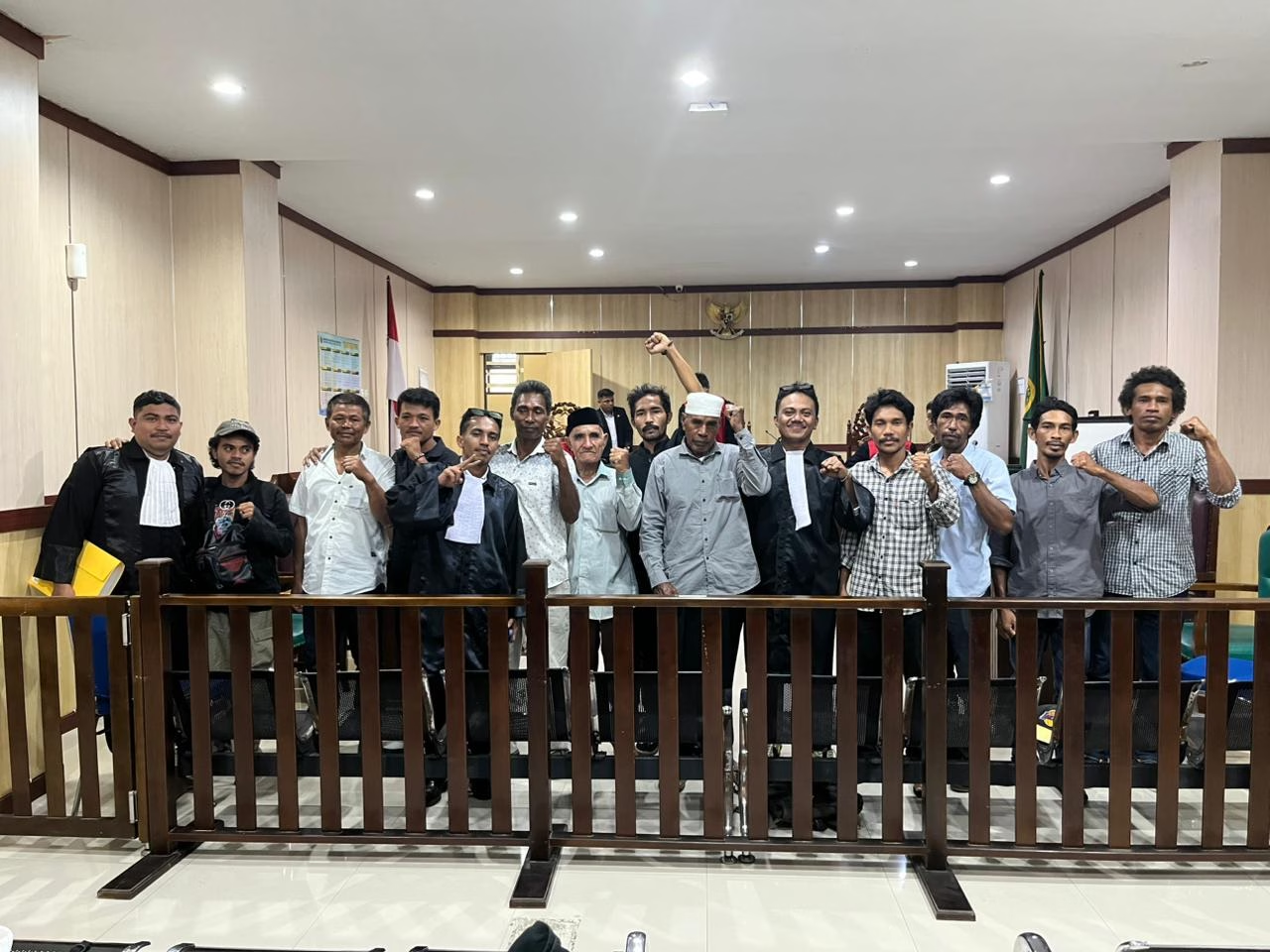
On October 16, 2025, the judges at the Soasio District Court delivered a dark verdict. All 11 villagers were found guilty. Most were sentenced to five months and eight days in prison, while three others received an additional two months due to overlapping charges.
Tragically, the panel of judges completely disregarded Anti-SLAPP (Strategic Lawsuit Against Public Participation) guidelines. The court refused to recognize them as environmental defenders protected under Article 66 of Indonesia’s Environmental Protection and Management Law. The reasoning was as cliché as it was deadly: the location was classified by the state as a “Permanent Production Forest,” and the community lacked written, formalized regulations proving their indigenous land rights.
The judges ignored the undeniable fact that this land had sustained the community for centuries, long before PT Position’s mining permit was signed in 2017. In that courtroom, state law made its stance clear: a corporate permit on paper holds more value than the ancestral rights of an indigenous community.
The Faces of the Guardians of Life
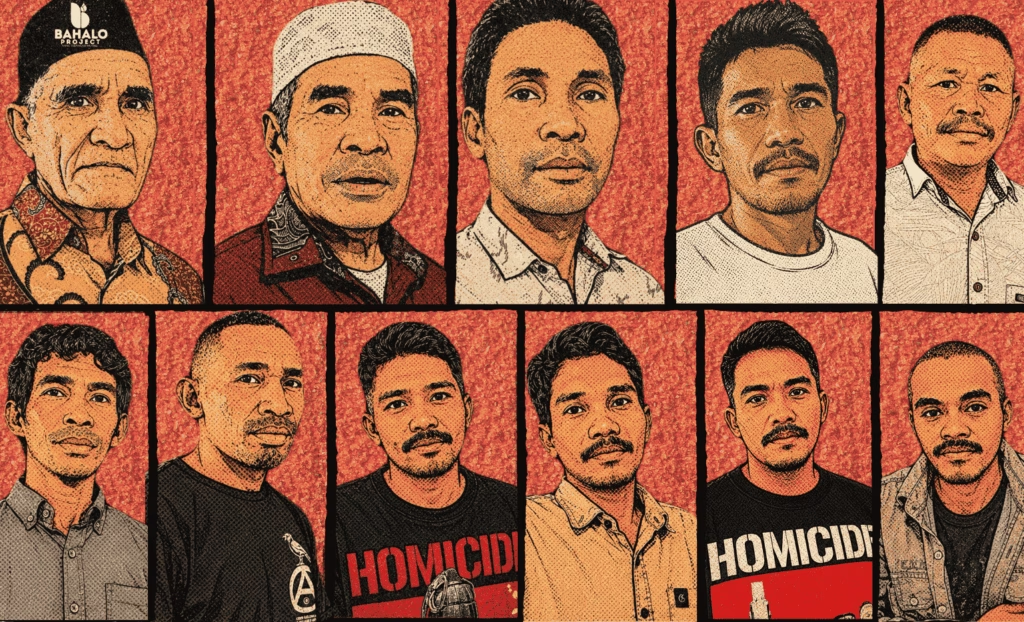
The 11 criminalized individuals are not criminals. They are the very heartbeat of the village.
Take Salasa Muhammad, the 81-year-old village elder born two months before Indonesia’s independence. Nicknamed “Tete Malawang” (Grandpa the Resister) for his unwavering resolve, Salasa has been imprisoned three times in his life for defending his land: resisting forced relocation in the 1970s, driving out a logging company in 1996, and now fighting the nickel mine. For him, surrender is not an option.
“Even if my life is the wager, I am ready to fight until my last drop of blood,” he wrote in a letter from the Ternate detention center.
There is also the protector figure, Umar Manado (68), the kapita darat whose hands were handcuffed mid-prayer. And brothers Alauddin Salamuddin (44) and Nahrawi Salamuddin (43), simple farmers whose nutmeg orchards are threatened by the ecological destruction surrounding them.
For sand miners and brickmakers like Sahrudin Awat (50) and Yasir Hi. Samad (39), the destruction of the Sangaji River means the ruin of their daily livelihoods. When Yasir was imprisoned, his family had to drain their savings meant for building a house just to survive and pay off their pickup truck installments.
In the eyes of young farmers like Sahil Abubakar (34), the mine is nothing but a “Papancuri” (robber) that destroys the soil, pollutes the water, and invites disaster. Echoes of resistance also came from Hamim Djamal (32), as well as Jamaluddin Badi (32) and Julkadri Husen (30), two young men from the neighboring Patani region who stood in solidarity, understanding that the destructive power of extractive industries knows no borders.
The movement even extended to urban activists. Indrasani Ilham (25), Chairman of the Nahdliyin Front for Natural Resource Sovereignty (FNKSDA) in Ternate, was imprisoned alongside them because he stood firmly in defense of the Maba Sangaji community.
The Final Battle at the Supreme Court
Today, although all the men were released by late 2025, the suffering is far from over. In the village, the exploitation continues unabated. The forest is still being stripped, traditional gardens are buried under mud during floods, and the river water is no longer safe to drink. More heartbreakingly, horizontal conflicts have begun to seep in. The shadow of mining money is fracturing the community, tearing apart neighbors, relatives, and even fathers and sons in Maba Sangaji.
Yet, the resistance is not dead. Currently, the 11 environmental defenders are filing for a Judicial Review (PK) at the Indonesian Supreme Court. They are demanding the restoration of their good names and legal recognition that their protests were legitimate, legally protected actions to safeguard the environment—not criminal offenses.
The Maba Sangaji case is a blaring emergency alarm for Indonesia. If the Supreme Court fails to overturn this conviction, Article 162 of the Mining Law will increasingly become a weapon of mass destruction against grassroots movements resisting the devastating impacts of mining across the archipelago.
While the Indonesian government heavily promotes nickel downstreaming as a crucial step for a “green” and environmentally friendly global energy transition, the cries of the Maba Sangaji villagers tell the exact opposite reality. They reveal that behind every electric vehicle battery produced, there is a blackened river, a silenced magical forest, and imprisoned guardians of life.
Collaborative reporting by Ekuatorial with Bahalo Project.
- An Urgent Plea for International Aid from the Heart of Indonesia’s Toxic Haze Crisis
- How the Savannas of Nusa Tenggara Became Indonesia’s New Epicenter for Land Fires
- Why World Mangrove Day Requires Action, Not Just Rhetoric?

- Fair Finance Asia Promotes Collaboration on Energy Transition

- The Smoke Crisis and Methane Time Bomb at Jatiwaringin Landfill
- One Year Since the Maba Sangaji Forest Tragedy